


Unlock/Research Components Instead of Blocks
Currently progression is gated by production blocks, resources and block unlocks.
First, you need the right production block (Smelter, Refinery, Assembler, Fabricator) and the required resources. Second, the block itself must be unlocked through the Colonization progression. In Free Sandbox, on the other hand, everything is unlocked from the start, which isn't ideal either.
I'd like to suggest changing the progression from unlocking blocks to unlocking components.
The basic idea is simple. Production block has a list of components it can make, but you will aslo need a component blueprint datapad to unlock producing specific components. Each production block will have a (dedicated) inventory where you will place unlocking datapads.
Component Blueprint Datapads
Each component has its own Component Blueprint Datapad (CBD).
A production block can only manufacture components for which it has the corresponding blueprint "installed".
Basic components like Steel Plates, Construction Components or Steel Tubes could be unlocked by default. Those are common engineering knowledge and enough for repairs and building simple structures. Of course, world settings could optionally lock even those for more restrictive scenarios.
This means that simply having an Assembler and the required resources no longer automatically gives access to every component it can potentially make.
Obtaining Component Blueprints
There should be multiple ways to obtain CBD so different playstyles remain viable.
You could buy them from NPC stations. More advanced blueprints would require higher reputation and cost more.
Colonization contracts could reward you with Component Blueprint Datapads instead of arbitrarily unlocking blocks. The reward becomes an actual in-game item that you found during the mission.
Blueprints could also appear as loot. Simpler ones might be found in "Unknown Signals", while advanced ones could be rewards from difficult encounters and in dangerous locations.
Finally, players could obtain them through research.
Research
Research is performed using a Research Block.
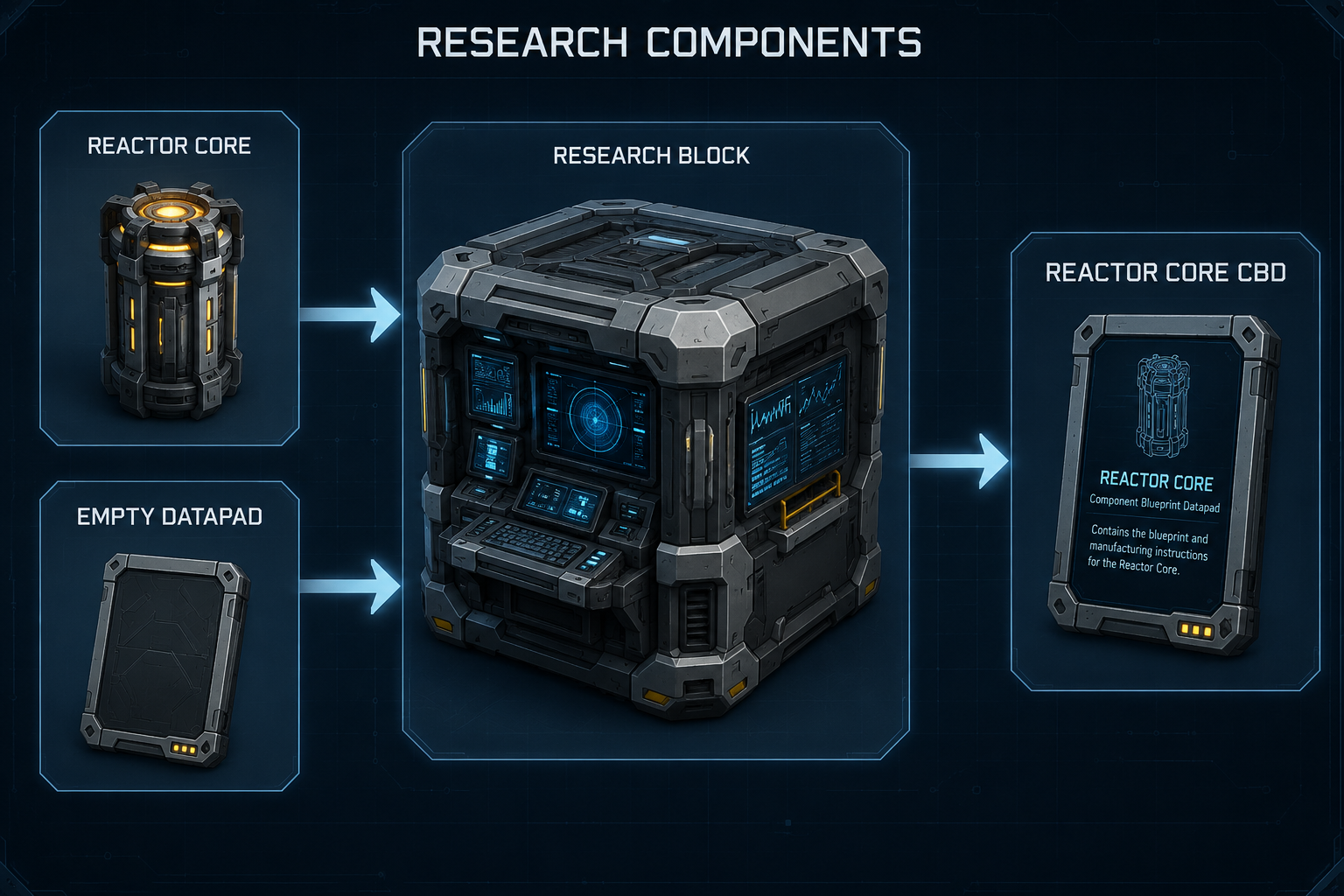
Instead of researching blocks (like in this suggestion), you research individual components.
To research a component, you feed existing examples of that component into the Research Block and at least one empty datapad. Then you order the research of specific component. You will see the exact number of components required for the research. If you don;t have enough components the research cannot be done. Mecanically, it is the same as producing any item in the production blocks. You basically crafting a CBD by combining certain number of components and an empty datapad.
For example, imagine you found a Drill in one of those Unknown Signals.
A Drill contains something like six compressor components, iirc.
If researching the compressor blueprint requires eighteen compressors, you now have an interesting decision to make.
Do you grind the Drill down and recover six compressors, then search for two more drills so you can eventually unlock compressor components production forever?
Or do you simply attach the Drill to your mining rig and keep using it until you find more later?
Research therefore still requires exploration, trading, salvaging or interacting with NPCs. You can't simply sit in your base and unlock everything from nothing. (Unless you turn off unlocks in world options ofc)
Copying Blueprints
Blueprints could be copy protected. You can "seal" the CBD at any time, making it copy protected, but it is a non-reversable operation ofc. A clear confirmation dialog would appear to avoid players accidentally making them "sealed".
Some blueprints found as loot or bought from NPCs could be copy protected. Others, especially those researched by the player, would be copyable by default.
Copies are produced using the Research Block.
You insert one non-copy-protected Component Blueprint Datapad together with one or more empty datapads and order more copies.
The resulting blueprint datapads can then be put into additional production blocks or shared with other players.
To prevent bypassing the system, Component Blueprint Datapads would be non editable. You can't simply copy their contents into a normal datapad or paste them in chat. They will probably contain an image of the component, a list of blocks they are used in and additional wiki about how to use them.
This keeps them as meaningful gameplay items while still allowing players to duplicate and distribute them once they have legitimately obtained a non-copy-protected version.
Why components instead of blocks?
Many blocks already depend on unique components.
A Drill requires Compressors.
A Reactor requires Reactor Cores.
More advanced blocks often require combinations of several advanced components.
This naturally groups related technologies together without having to define separate unlocks for every individual block.
Unlock Compressors and you automatically gain access to every block that depends on Compressors, provided you also have the other required components and production facilities.
The progression becomes more flexible and much easier to expand in the future. If you add a new vanilla or modded block it will automatically follow the progression gating depending on components used to make it.
Bonus idea: 3D Printers
This system opens the door for many interestin gscenarios, including having small onboard 3D printers.
Unlike Assemblers or Fabricators, these wouldn't be intended for mass production. They would consume more resources, work much slower and still require the appropriate Component Blueprint Datapads.
Their purpose would be emergency manufacturing.
A ship could carry a small reserve of raw materials (or even mine them on the go) and a compact 3D printer to produce a few replacement components while away from base. That makes field repairs possible without carrying an entire industrial production line everywhere.
For regular manufacturing they would simply be too slow and inefficient to replace dedicated production facilities, so large factories would still remain the preferred solution.
 I like this feedback
I like the direction of this post
The SE discord Overton window of peers is too small at the moment to get a balanced opinion from, many schools of thought have gradually been evicted, eviscerated or generally griefed into silence.
An open mind thinks that the elements of an idea are good and looks for ways to improve or overcome the pitfalls, a closed mind may be comfortable with the status quo and see new proposals as a threat, any means to discredit the idea is sort out.
I would like to see improvements and a relaxing of the current entrenchment on that board.
That aside keep up the good work.
I like the direction of this post
The SE discord Overton window of peers is too small at the moment to get a balanced opinion from, many schools of thought have gradually been evicted, eviscerated or generally griefed into silence.
An open mind thinks that the elements of an idea are good and looks for ways to improve or overcome the pitfalls, a closed mind may be comfortable with the status quo and see new proposals as a threat, any means to discredit the idea is sort out.
I would like to see improvements and a relaxing of the current entrenchment on that board.
That aside keep up the good work.
with this method would you need cbd for each component, in each different production block you make?
so, i have a base with "everything" then i have my runaround ship wich just has a gearforge and smelter, maybe an assembler, to keep weapons stocked, but i would need multiple copies of the same cbd for the two different grids production blocks?
with this method would you need cbd for each component, in each different production block you make?
so, i have a base with "everything" then i have my runaround ship wich just has a gearforge and smelter, maybe an assembler, to keep weapons stocked, but i would need multiple copies of the same cbd for the two different grids production blocks?
Nice idea 4Peace, hope the CBD idea can be expanded to whole grid blueprints, somehow, as well. As an itemized blueprint you can carry around, and some sort of copy protection incorporated (maybe faction 'tags').
Couple concerns, though:
1. Is this system a.i. agnostic? Can I go to an unknown signal and loot/steal all the CBDs they have? Will they be stuck unable to make anything, then? Can I steal these from players on a server? If I find you, could I access your production blocks and steal all your CBDs? Can a.i. pirates steal from me? Does that require every production facility of the a.i. having production blocks/research blocks invulnerable to looting? (edit)-And most importantly, how would the a.i. progress autonomously with this...? Can this be used in a 'living' world?
2. We have a set number of components for all the blocks, so any block added by mods or expansions would be automatically unlocked, if we already have all the CBDs? Would that require a new 'component' to be released with each new block idea, if we wanted another expansion to the 'progression' of the game?
3. If I steal CBDs from an npc, how quick can I unlock all the blocks I would need? If there are hundreds of blocks, and hundreds of hours in a play run, how long will this system last the player until it is irrelevant to 'progression' and is instead a 'production' loop addition to their plans?
4. "This system opens the door for many interesting scenarios, including having small onboard 3D printers.
Unlike Assemblers or Fabricators, these wouldn't be intended for mass production. They would consume more resources, work much slower and still require the appropriate Component Blueprint Datapads.
Their purpose would be emergency manufacturing."
--lol, this sounds like the old Survival Kit. I make the case this logic should be applied to backpack 'manufacturing' and the Survival Kit, as a survival type of scenario ;) The thing you would use when stranded until you can get your base up and running.
5. Since progression is not tied to the player, but to an item that he has to carry around and protect, how is this really that different from the actual blocks he has to build/carry around, and protect? If progression was a pure 'unlock', then it would be a part of his identity, his progression, and would persist through with him on his play run, no matter what happens to him. It would be like his player 'level' in the game. A lot of players like this, as this simulates the 'growth' of your character. When that is removed and itemized, and is destroyable, that is like a permadeath setting on an rpg.
Nice idea 4Peace, hope the CBD idea can be expanded to whole grid blueprints, somehow, as well. As an itemized blueprint you can carry around, and some sort of copy protection incorporated (maybe faction 'tags').
Couple concerns, though:
1. Is this system a.i. agnostic? Can I go to an unknown signal and loot/steal all the CBDs they have? Will they be stuck unable to make anything, then? Can I steal these from players on a server? If I find you, could I access your production blocks and steal all your CBDs? Can a.i. pirates steal from me? Does that require every production facility of the a.i. having production blocks/research blocks invulnerable to looting? (edit)-And most importantly, how would the a.i. progress autonomously with this...? Can this be used in a 'living' world?
2. We have a set number of components for all the blocks, so any block added by mods or expansions would be automatically unlocked, if we already have all the CBDs? Would that require a new 'component' to be released with each new block idea, if we wanted another expansion to the 'progression' of the game?
3. If I steal CBDs from an npc, how quick can I unlock all the blocks I would need? If there are hundreds of blocks, and hundreds of hours in a play run, how long will this system last the player until it is irrelevant to 'progression' and is instead a 'production' loop addition to their plans?
4. "This system opens the door for many interesting scenarios, including having small onboard 3D printers.
Unlike Assemblers or Fabricators, these wouldn't be intended for mass production. They would consume more resources, work much slower and still require the appropriate Component Blueprint Datapads.
Their purpose would be emergency manufacturing."
--lol, this sounds like the old Survival Kit. I make the case this logic should be applied to backpack 'manufacturing' and the Survival Kit, as a survival type of scenario ;) The thing you would use when stranded until you can get your base up and running.
5. Since progression is not tied to the player, but to an item that he has to carry around and protect, how is this really that different from the actual blocks he has to build/carry around, and protect? If progression was a pure 'unlock', then it would be a part of his identity, his progression, and would persist through with him on his play run, no matter what happens to him. It would be like his player 'level' in the game. A lot of players like this, as this simulates the 'growth' of your character. When that is removed and itemized, and is destroyable, that is like a permadeath setting on an rpg.
Eh, I don't know.
This mechanic exists in Satisfactory and Star Rupture, and while I think "research" or "delivering X to receive Y tech" in layers works for a game where there is no resource scarcity, and then even if you level the base, you have still keep the research. It works in those games because the progression flow is basically "refine resource, ship. refine resource, assemble item, ship, refine resources, assemble items, assemble more complex items, ship" until you get to the final stage which doesn't require unlocking everything, just the machines necessary to assemble the materials for the final stage. For Satisfactory, these are items that you can't make on the workbench. You are required to make all the necessary machines, or discover alternative recopies for the precursor materials.
There are two alternative progression points in satisfactory, finding the hard drives that unlocks alternative recipes, sometimes they are more efficient (Eg making pipes from iron and not steel) and sometimes they just make more product by using water in the process. And then there is the MAM which is is just a bunch of tech tries that lets you get access to some tech earlier than it appears in the Hub, and sometimes just gives you things for the player (eg tool upgrades/healing items) that you can produce with a separate workshop that produces mainly just items for the player's use.
With SE2, it seems like the blueprints/licenses aren't meant to be researched at all, just issued. Which is fine, except the way to get them is disconnected from the mission requirements. To give you an example, to be able to build the various cargo blocks, should be from missions to deliver raw materials or constructed resources, and thus the next mission should ask for materials in a quantity that needs the previously unlocked cargo container. Same with things like weapons and engines.
Right now the game lacks "sink" items, items that you make entirely to sell to colonists/trade centers. In games like Starflight, Wing Commander Privateer, and Elite (First Encounters, I think), from the 90's, the main economic driver was trading items (or taxi'ing people) from starbases or land-based trading posts. In many cases, the items that the local trading post wants, are items that are available to mine/harvest on the same planet, but not in large quantities. If you want to make a lot of money, you need to find the actual planet that these products are harvested or manufactured on. In No Man's Sky, the trading system exists, but there is no incentive to engage in it once you have enough inventory slots unlocked on your character to not need the ship anymore. Once you figure out a trade route in NMS, you just repeat it over and over until you have more money than you can do anything with. Starfield, your make economic driver is just looting enemies bases and the gear from the enemies. Sure there is a base/factory element in the background in Starfield, but it's just pointless to invest much time in.
My general preference for unlocking tech is to "learn by trying", or "fog of war" unlocking where when you unlock an item, the next item is visible in the tech tree, so you know which precursor things you need to unlock to unlock the next item. How I'd see this work in SE2 would be to have a "tech tree" for each ore series. Eg "Iron tech tree", "Copper tech tree", "Gold tech tree", and when you unlock say "permanent magnet" on the iron tree, and "copper wire" on the copper tree, then it unlocks "electro magnet" and also "electromagnetic motor", "stator", "dynamo generator", which are all parts needed for the atmospheric thrusters, wind generator, wheels, and assembly drones. Unlocking "gold wire", and "fiberglass" (under silicon) gives microchips. Fiberglass blades for wind turbines (an alternative version of the wind turbine), heck unlocking fiberglass gives the player a series of non-armor parts for lightweight surface or sea craft parts.
I like having a lot of parts, as long as there is a logic to why they exist, I'd rather something be slightly less accurate if it would suck fun away to be too accurate, such as fuel/energy or wear. In many cases, wear/damage in a game makes it less fun because driving around a huge craft, that gets flung into the air and landing on it's roof every time it hits a pebble because the physics treats all voxels as immobile is something I'm willing to go "driving around a million tonne ship, should just be flattening whatever it lands on or drives over." Fuel and Energy should, realistically reflect the time-acceleration of the game, but maybe not the the burn rate, otherwise it would make most ships immobile since you can't build enough solar to realistically fire ion engines or atmospheric engines without multiple banks of batteries. And right now you can cheese that by constantly building and deconstructing the batteries when they run out.
Hence a tech tree for energy generation and storage I'd want to exist where, "carbon", "iron", "lead", "nickel" (cadmium or NIMH (Nickel Hydroxide)), "Lithium", are all battery/module types that have different energy densities, and for generation you'd have solar (requires silicon tech tree levels), Wind (requires copper, different blade materials have different generation rates), Fission (requires Uranium/Plutonium), RTG's (Radioisotope thermoelectric generator) which requires radioactive nickel or tritium (hydrogen). RTG's would be something you'd find at POI's on asteroids. Fusion (requires lithium to build but generates electricity only if deuterium fuel is available.)
All that stuff makes logical sense to me, but to another player they just want the biggest bang for their time, so a lot of intermediate stuff is usually discarded. Hence why the game has to balance between "making many cheap things" or "make one expensive thing" in some solutions. Like a space station might have "many cheap things" distributed over the base to avoid having a single point of failure, while smaller ships that aren't factories might only have batteries and a single hydrogen engine for an afterburner.
Eh, I don't know.
This mechanic exists in Satisfactory and Star Rupture, and while I think "research" or "delivering X to receive Y tech" in layers works for a game where there is no resource scarcity, and then even if you level the base, you have still keep the research. It works in those games because the progression flow is basically "refine resource, ship. refine resource, assemble item, ship, refine resources, assemble items, assemble more complex items, ship" until you get to the final stage which doesn't require unlocking everything, just the machines necessary to assemble the materials for the final stage. For Satisfactory, these are items that you can't make on the workbench. You are required to make all the necessary machines, or discover alternative recopies for the precursor materials.
There are two alternative progression points in satisfactory, finding the hard drives that unlocks alternative recipes, sometimes they are more efficient (Eg making pipes from iron and not steel) and sometimes they just make more product by using water in the process. And then there is the MAM which is is just a bunch of tech tries that lets you get access to some tech earlier than it appears in the Hub, and sometimes just gives you things for the player (eg tool upgrades/healing items) that you can produce with a separate workshop that produces mainly just items for the player's use.
With SE2, it seems like the blueprints/licenses aren't meant to be researched at all, just issued. Which is fine, except the way to get them is disconnected from the mission requirements. To give you an example, to be able to build the various cargo blocks, should be from missions to deliver raw materials or constructed resources, and thus the next mission should ask for materials in a quantity that needs the previously unlocked cargo container. Same with things like weapons and engines.
Right now the game lacks "sink" items, items that you make entirely to sell to colonists/trade centers. In games like Starflight, Wing Commander Privateer, and Elite (First Encounters, I think), from the 90's, the main economic driver was trading items (or taxi'ing people) from starbases or land-based trading posts. In many cases, the items that the local trading post wants, are items that are available to mine/harvest on the same planet, but not in large quantities. If you want to make a lot of money, you need to find the actual planet that these products are harvested or manufactured on. In No Man's Sky, the trading system exists, but there is no incentive to engage in it once you have enough inventory slots unlocked on your character to not need the ship anymore. Once you figure out a trade route in NMS, you just repeat it over and over until you have more money than you can do anything with. Starfield, your make economic driver is just looting enemies bases and the gear from the enemies. Sure there is a base/factory element in the background in Starfield, but it's just pointless to invest much time in.
My general preference for unlocking tech is to "learn by trying", or "fog of war" unlocking where when you unlock an item, the next item is visible in the tech tree, so you know which precursor things you need to unlock to unlock the next item. How I'd see this work in SE2 would be to have a "tech tree" for each ore series. Eg "Iron tech tree", "Copper tech tree", "Gold tech tree", and when you unlock say "permanent magnet" on the iron tree, and "copper wire" on the copper tree, then it unlocks "electro magnet" and also "electromagnetic motor", "stator", "dynamo generator", which are all parts needed for the atmospheric thrusters, wind generator, wheels, and assembly drones. Unlocking "gold wire", and "fiberglass" (under silicon) gives microchips. Fiberglass blades for wind turbines (an alternative version of the wind turbine), heck unlocking fiberglass gives the player a series of non-armor parts for lightweight surface or sea craft parts.
I like having a lot of parts, as long as there is a logic to why they exist, I'd rather something be slightly less accurate if it would suck fun away to be too accurate, such as fuel/energy or wear. In many cases, wear/damage in a game makes it less fun because driving around a huge craft, that gets flung into the air and landing on it's roof every time it hits a pebble because the physics treats all voxels as immobile is something I'm willing to go "driving around a million tonne ship, should just be flattening whatever it lands on or drives over." Fuel and Energy should, realistically reflect the time-acceleration of the game, but maybe not the the burn rate, otherwise it would make most ships immobile since you can't build enough solar to realistically fire ion engines or atmospheric engines without multiple banks of batteries. And right now you can cheese that by constantly building and deconstructing the batteries when they run out.
Hence a tech tree for energy generation and storage I'd want to exist where, "carbon", "iron", "lead", "nickel" (cadmium or NIMH (Nickel Hydroxide)), "Lithium", are all battery/module types that have different energy densities, and for generation you'd have solar (requires silicon tech tree levels), Wind (requires copper, different blade materials have different generation rates), Fission (requires Uranium/Plutonium), RTG's (Radioisotope thermoelectric generator) which requires radioactive nickel or tritium (hydrogen). RTG's would be something you'd find at POI's on asteroids. Fusion (requires lithium to build but generates electricity only if deuterium fuel is available.)
All that stuff makes logical sense to me, but to another player they just want the biggest bang for their time, so a lot of intermediate stuff is usually discarded. Hence why the game has to balance between "making many cheap things" or "make one expensive thing" in some solutions. Like a space station might have "many cheap things" distributed over the base to avoid having a single point of failure, while smaller ships that aren't factories might only have batteries and a single hydrogen engine for an afterburner.
Does this imply that in order to produce a component, you need to find it more than once somewhere in the world and learn from those instances? Meaning, you cannot learn it without having copies of?
This sounds more like reverse engineering rather than actual research.
Does this imply that in order to produce a component, you need to find it more than once somewhere in the world and learn from those instances? Meaning, you cannot learn it without having copies of?
This sounds more like reverse engineering rather than actual research.
If CBD (Components Blueprint Datapad) sounds too weird, I think Production Recipe or PR could be a better name :)
If CBD (Components Blueprint Datapad) sounds too weird, I think Production Recipe or PR could be a better name :)
I like the 3D printer bonus idea. It could also work nicely hand in hand with an idea I suggested elsewhere:
The backpack would contain a similar 3D printer, but not a mini refinery. Backpack building would then only be possible with either pre-manufactured components or the same kind of filaments the 3D printer block uses. The 3D printer block would have a somewhat greater assortment of materials it can use, but backpack and 3D printer block would share the disadvantages in greater resource usage and lower build speed speed.
I like the 3D printer bonus idea. It could also work nicely hand in hand with an idea I suggested elsewhere:
The backpack would contain a similar 3D printer, but not a mini refinery. Backpack building would then only be possible with either pre-manufactured components or the same kind of filaments the 3D printer block uses. The 3D printer block would have a somewhat greater assortment of materials it can use, but backpack and 3D printer block would share the disadvantages in greater resource usage and lower build speed speed.
Terrible idea. just no. unlocks should give an immediate reward, unlocking new blocks does that. It's also overly complicated. I
Terrible idea. just no. unlocks should give an immediate reward, unlocking new blocks does that. It's also overly complicated. I
I hope that this would mean many more component types, like an additional hundred or so.
I hope that this would mean many more component types, like an additional hundred or so.
It's a good start, but it needs more refinement to not stretch the learning curve more than it's already going to be.
I think a middle ground is to indeed have the research block, but simply make it cost components x amount in order to unlock new components.
You could unlock compressors by researching the ... research, using 20 motors in the process.
Or heavy plates by researching them with 100 normal steel plates as the cost.
That at least keeps it relatively simple to get new components, but also puts them behind a new system.
Though you would need to be sure and not limit basic components to build things. Otherwise researching a drill component like the compressor becomes tedious to hand mine all ore just to get there... sure it's rewarding, but if you make it too difficult ten it becomes a chore and players will see it as a tedious task and turn research off entirely.
I like the idea, but it needs a lot of fine-tuning for a good implementation.
It's a good start, but it needs more refinement to not stretch the learning curve more than it's already going to be.
I think a middle ground is to indeed have the research block, but simply make it cost components x amount in order to unlock new components.
You could unlock compressors by researching the ... research, using 20 motors in the process.
Or heavy plates by researching them with 100 normal steel plates as the cost.
That at least keeps it relatively simple to get new components, but also puts them behind a new system.
Though you would need to be sure and not limit basic components to build things. Otherwise researching a drill component like the compressor becomes tedious to hand mine all ore just to get there... sure it's rewarding, but if you make it too difficult ten it becomes a chore and players will see it as a tedious task and turn research off entirely.
I like the idea, but it needs a lot of fine-tuning for a good implementation.
Replies have been locked on this page!