


Detaching & Attaching Blocks. Scrapyard Survival.
Hello, my fellow scrapyard engineers 👋
Right now, there’s no easy way to detach a block or a section of a grid without destroying everything it’s connected to. We’ve all been there: salvaging Factorum or other encounters, wanting to recover valuable blocks intact, or trying to move our own blocks without grinding them down. Think about big block like fabricators, refineries, or jump drives.
Or think about playing a scrapyard scenario, or any playstyle that doesn’t rely on the traditional mining-production loop, or only uses it partially. In all these cases, the lack of a clean way to detach and reattach blocks makes the process more tedious and less immersive.
This gets even more interesting if grinding could optionally produce scrap instead of components. That could be a difficulty setting or even useful option for backpack building. For example, you grind down a catwalk into iron scrap, then use that scrap to backpack-build any other iron-based block.
In that context, being able to detach and reattach blocks becomes even more valuable as you do not want to craft all the components again from the scrap or even lose some part of materials during grinding.
How would detaching work?
With a grinder, of course 🙂
Just like the hand drill has a secondary terrain-clear mode, the grinder could have a secondary detach mode.
- Aim at a block with a grinder.
- The connected surfaces in the direction you’re looking at highlight.
- Hold RMB to “grind” those connections.
- After a short time, the highlight changes color, showing the connection is gone.
If nothing else is holding the block, it detaches immediately. If it’s still connected somewhere else, you just repeat the process on the remaining sides or nearby blocks until the whole section comes free. This feels both realistic and intuitive, plus showing you connection points is useful on its own.
Example:
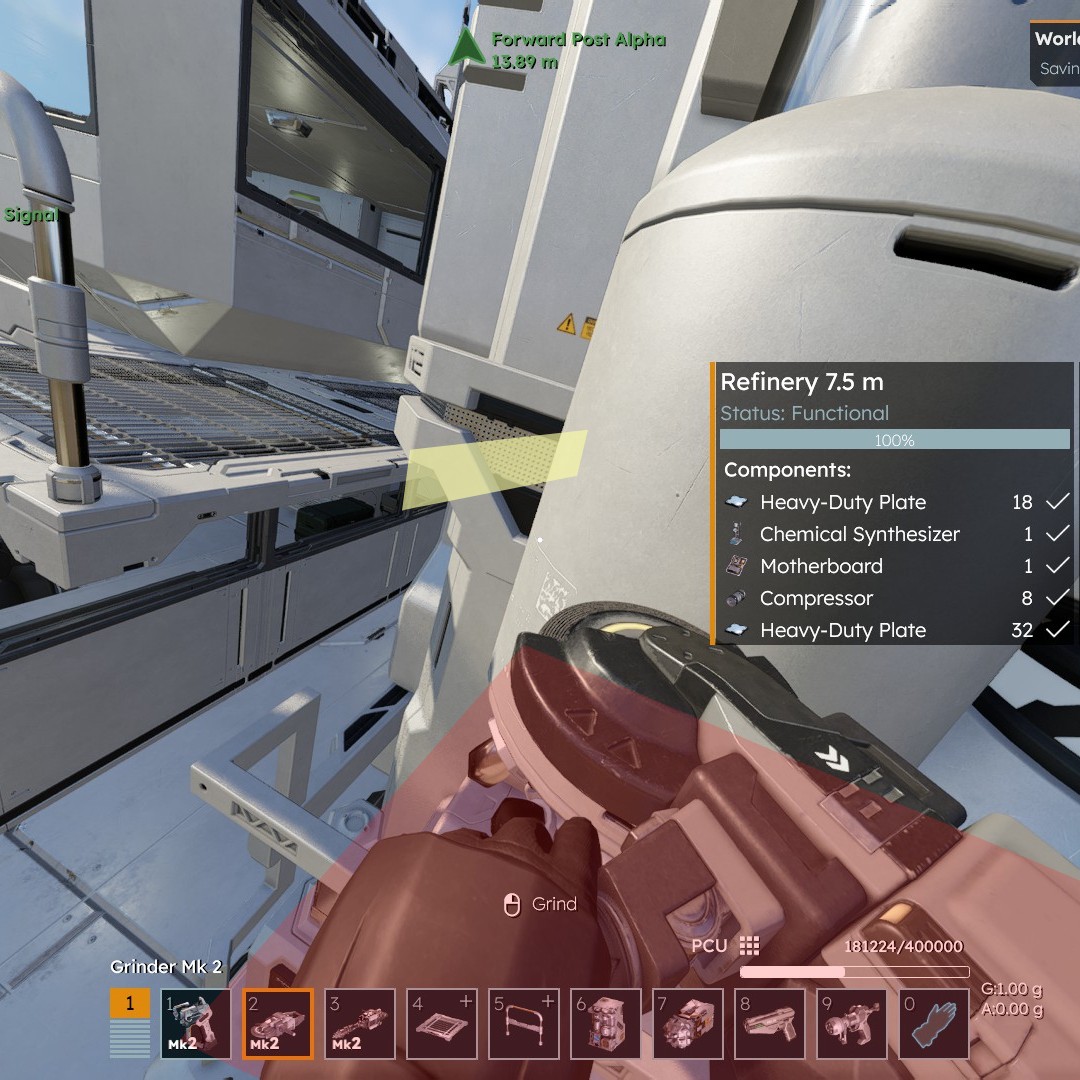
You have a refinery sitting on the floor. Instead of tearing up half the base underneath it, you simply stand next to it and look slightly down. The bottom attachment highlights. Use the grinder to grind the connection until the highlight turns red. Still attached? Look at that side and notice a couple of catwalks and it show you the connection with yellow highlight. Grind those connections as well. Done. The refinery is now a separate grid, free to move wherever you want.
Figure 1. Highlighting attachemnt on the bottom of the block
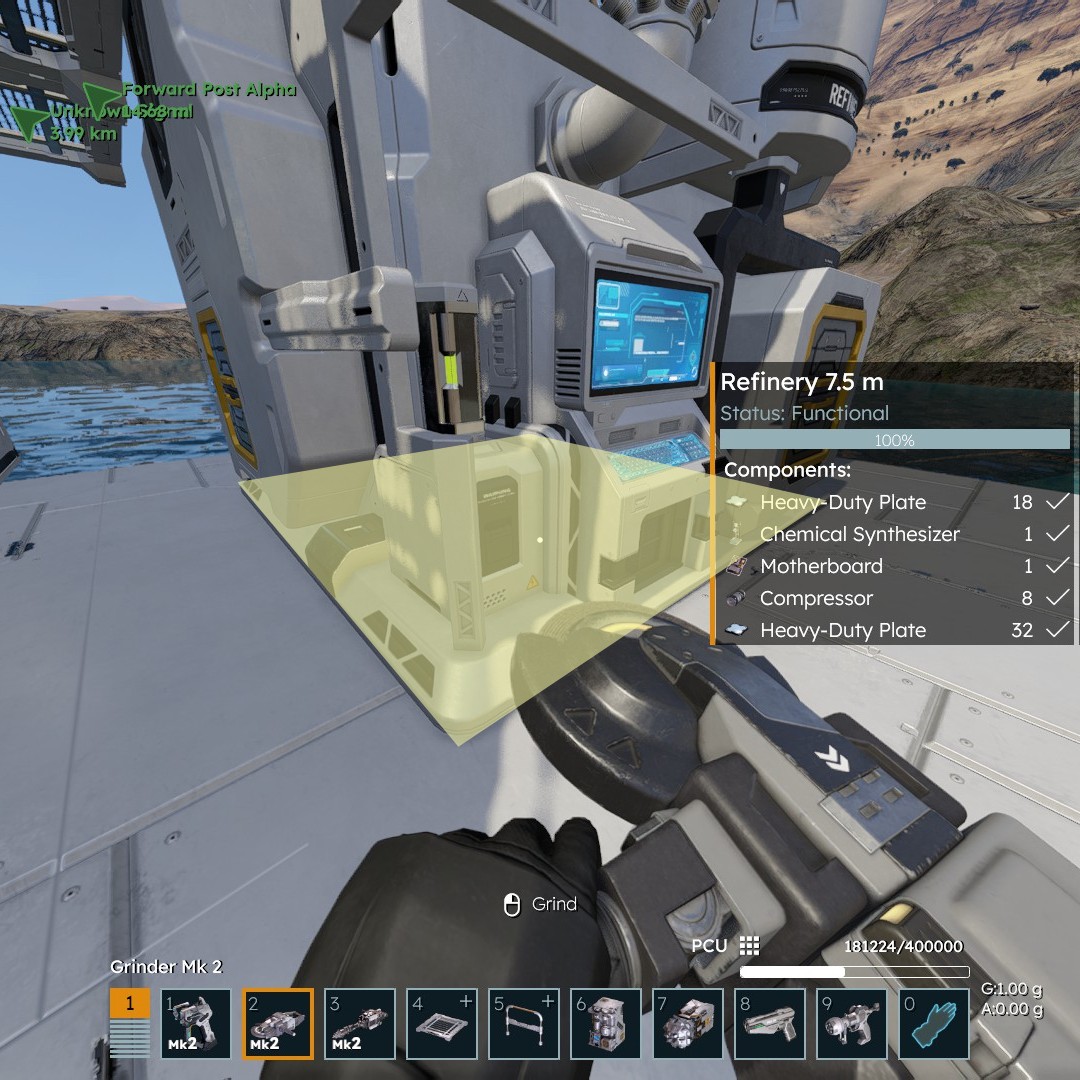
Figure 2. No more attachment on the bottom, weady to detach other blocks on the side.
And attaching it back?
Also simple, and no merge block required.
- Take out a welder.
- Aim the detached block (or grid) near another grid.
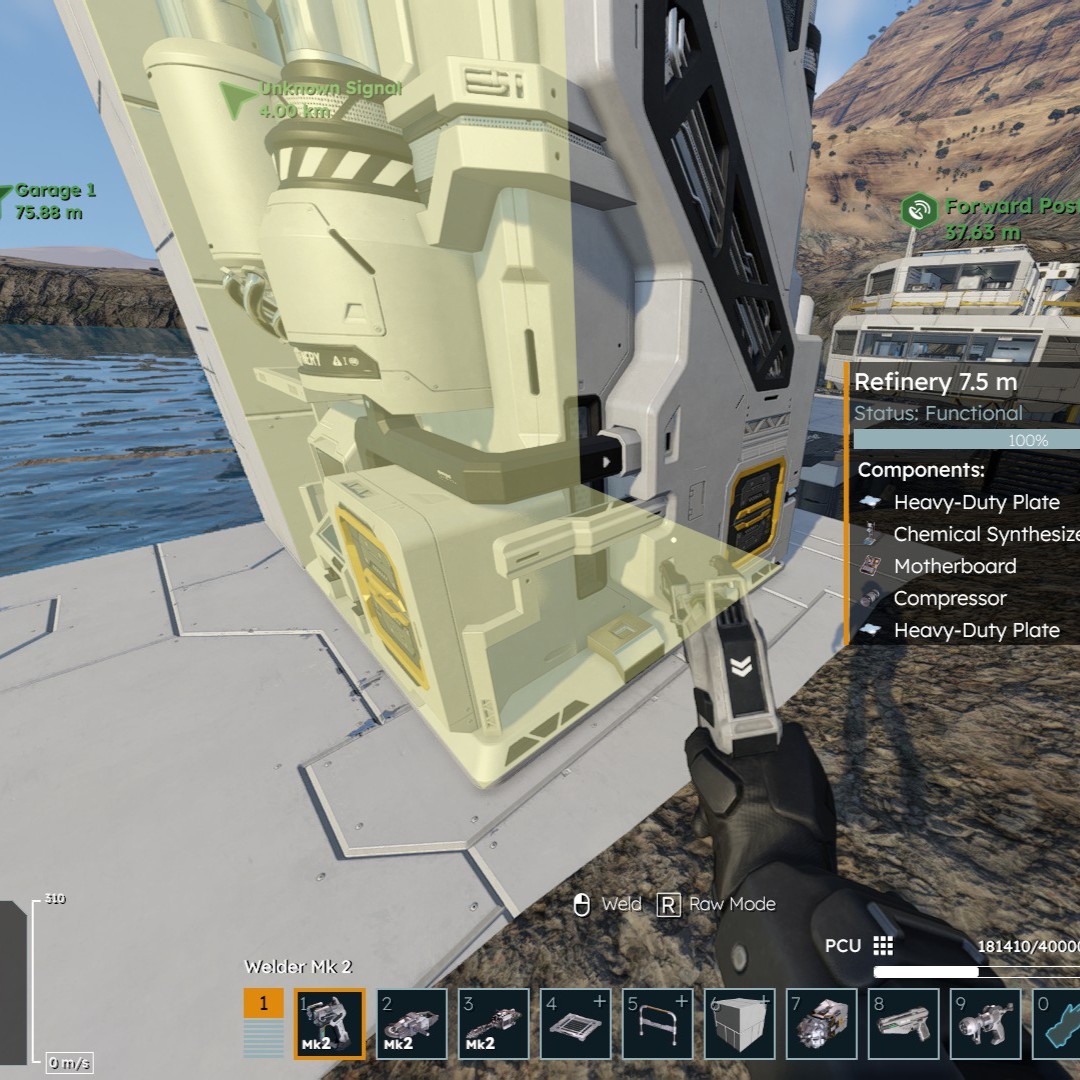
- Nearby attachable surfaces highlight so you can clearly see where it will connect.
- Hold RMB to weld it in place.
Welding could take a bit longer depending on the surface area.
Figure 3. Refinery positioned near armor blocks at the bottom and on the side showing where it will attach.
Why this would be awesome?
I think you already know, but here are some of the most noticeable possibilities, this system opens up:
- Less rigid base planning
The refinery example is just one of many use cases. You no longer need to carefully plan everything far in advance or build those strange, never-really-finished semi-permanent bases with intentionally reserved empty space “just in case.” and live with all this ugliness for a while. Instead, your base can naturally grow and evolve over time. If you need more room or decide to change something, you simply move blocks or whole sections to a new place. - Modular bases and outposts
On your main base, you could keep a relatively small setup to print modules or sections. These can then be used on site or transported and attached to other outposts or secondary bases, instead of welding everything on site, which is often inconvenient in gravity. - Missions and Campaign
There can be various interesting campaing missions or contracts that ask you to do certain tasks like "detach this thing and attach elsewhere", "deliver this weather station module to the platform at GPS coords and attach it there", "finish the she ship and separate it from the base (it might be connected by a cockpit so it feels natural to avoid grinding it down lol)" and so on. - Easier ship construction
You could build sections of larger ships separately and then connect them together, without relying on massive and cumbersome printers or worrying about always having space for temporary merge blocks. Once mechanical blocks are in the game, building cranes to assist with building larger would also become an interesting option eben on planets. - Next-level space shipyards
Space-based shipyards would benefit hugely. You could still use large welder walls or printers, but you would also have the option to use much smaller printer setups to rapidly build smaller grid sections and then assemble them using tug ships. Use those salvaged jump drives or whatever to easily incorporate in your builds. bring your existing ships back to the shipyard to upgrade/modify them. Becasue let's be honest, without possibility for easy detachment and attachment of grid parts, you would rather throw it away and build a new one. - Interact with NPC and Economy
You can also buy one of those ships on NPC station for the base hull, update it, use it for some kind of activity to gather more materials or money, and then repeat the upgrade cycle. - More engaging and PCU-friendly building
This opens up entirely new dimensions for survival engineering and ship/base design. It supports a more modular or section-based approach to building. And having smaller printers is just more performance friendly, require less materials to build and less restrictive when things like max welders number is set on the server. Your shipyard can look more like a shipyard where you make ships and not like a giant windmill. 🙂 - A huge boost for scrapyard and scavenger playstyles
Last but not least, and somewhat obvious, scrapyard-focused gameplay—or many others, such as pirating or doing contracts and scavenging. I want to have many equally viable options to progress in survival, besides mining/production loop.
And this really matters for vanilla gameplay. Mods can only go so far. A system like this needs to be deeply integrated into the core game to feel polished, balanced, and truly enjoyable for old and new players.
I genuinely believe this could be one of those features that makes SE2 stand out for years to come or even make Space Engineers 2 immortal. 🚀
And I’d really love to hear what you guys would do with a system like this. I’m sure there are tons of ideas already forming in your heads, I hope this can feed your "need to create". 🙂
 I like this feedback
After playin SE1 for years I kinda burned out, not gonna lie. Did the usual survival, mined stupid amount of ore, big bases, big ships same loop again and agin. Then one day I randomly stumbled on Splitsie’s scrapyard survival videos… and damn. That completely pulled me back in i tried it myself and it honestly made me love survival again. Like actually thinking, improvising, making weird stuff work with whatever junk you find. If anyone reading this hasn’t seen those videos, seriously, go watch them. They’re fun as hell and also show what SE survival could be.
Being able to detach and attach blocks just takes the sandbox to another level. Scrapyard kinda thing is just one example. I’m using block detach mod and welding patch mod in literally every survival playthrough now. I can’t go back the game just feels so limited once you’ve tasted that freedom.
And that’s with mods. Kinda janky sometimes… I can only imagine how insanely good it would be if this was done propely in vanilla, by the devs, fully integrated and polished.
Keen pls. Seriously. This alone makes me want to go back and play SE1 after 10+ years. If this was in SE2, I’d buy everything you sell, no joke, and I’d probably convince a bunch of friends to jump back in too.
After playin SE1 for years I kinda burned out, not gonna lie. Did the usual survival, mined stupid amount of ore, big bases, big ships same loop again and agin. Then one day I randomly stumbled on Splitsie’s scrapyard survival videos… and damn. That completely pulled me back in i tried it myself and it honestly made me love survival again. Like actually thinking, improvising, making weird stuff work with whatever junk you find. If anyone reading this hasn’t seen those videos, seriously, go watch them. They’re fun as hell and also show what SE survival could be.
Being able to detach and attach blocks just takes the sandbox to another level. Scrapyard kinda thing is just one example. I’m using block detach mod and welding patch mod in literally every survival playthrough now. I can’t go back the game just feels so limited once you’ve tasted that freedom.
And that’s with mods. Kinda janky sometimes… I can only imagine how insanely good it would be if this was done propely in vanilla, by the devs, fully integrated and polished.
Keen pls. Seriously. This alone makes me want to go back and play SE1 after 10+ years. If this was in SE2, I’d buy everything you sell, no joke, and I’d probably convince a bunch of friends to jump back in too.
so attaching and detaching blocks? i saw this in a battery mod and it was good. rather than grinding and rebuilding, it's essentially a move block from location A to location B. without having to fill up your inventory. i think this specifically would be a good idea.
so attaching and detaching blocks? i saw this in a battery mod and it was good. rather than grinding and rebuilding, it's essentially a move block from location A to location B. without having to fill up your inventory. i think this specifically would be a good idea.
This would be one way of making rare blocks work. Find rare block, detach it, reattach it to your own ship.
Alternative is grind block without breaking it into components (have the whole block in inventory), and then rebuild it as a whole block. This would carry its rare properties to a new location.
TBH I would have both - detach/attach, and move blocks in inventory without disassembly.
This would be one way of making rare blocks work. Find rare block, detach it, reattach it to your own ship.
Alternative is grind block without breaking it into components (have the whole block in inventory), and then rebuild it as a whole block. This would carry its rare properties to a new location.
TBH I would have both - detach/attach, and move blocks in inventory without disassembly.
The issue this solves, is if you grind a refinery down for example, you need 3-4 trips of emptying and refilling your inventory to place the refinery again, since the components it's made of are so heavy and so plentiful.
A weld away an attachment point, allows you to
- Detach the refinery = still welding time, but less.
- Detaching the refinery = no inventory management.
- Moving the refiner to new attachment spot = gravity gun is one conceptual way to do this.
- Placement could be as easy as holding ctrl and wasd etc. (same way we place blocks already).
Also this might save you painting time, since people paint some blocks, and change their paint pallet after. So moving a block means less time spent setting paint colour potentially compared to rebuilding the block.
The issue with block in inventory is that it could be argued it's miniaturization tech, (which is more crazy than a gravity gun) and people could take a refinery and be overweight, but then hop in a vehicle and speed away after. which means the over-encumbered part disappears unless a mechanic is added into the game where over-encumbered people can't access vehicles.
Gravity gun is probably an easier implementation to add to move bigger objects. For smaller objects the space engineer could physically carry them.
The issue this solves, is if you grind a refinery down for example, you need 3-4 trips of emptying and refilling your inventory to place the refinery again, since the components it's made of are so heavy and so plentiful.
A weld away an attachment point, allows you to
- Detach the refinery = still welding time, but less.
- Detaching the refinery = no inventory management.
- Moving the refiner to new attachment spot = gravity gun is one conceptual way to do this.
- Placement could be as easy as holding ctrl and wasd etc. (same way we place blocks already).
Also this might save you painting time, since people paint some blocks, and change their paint pallet after. So moving a block means less time spent setting paint colour potentially compared to rebuilding the block.
The issue with block in inventory is that it could be argued it's miniaturization tech, (which is more crazy than a gravity gun) and people could take a refinery and be overweight, but then hop in a vehicle and speed away after. which means the over-encumbered part disappears unless a mechanic is added into the game where over-encumbered people can't access vehicles.
Gravity gun is probably an easier implementation to add to move bigger objects. For smaller objects the space engineer could physically carry them.
Hey, I did a suggestion for the inventory side of things:
Block Slot for character inventory
Basically allow carrying a SINGLE block in character inventory. Detach -> Block Slot -> Attach.
That would be in addition to detach/attach where you manipulate the block in game world without it going to your inventory.
Some overlap I guess, if they implement this, the Block Slot would be somewhat redundant. Depends on what kind of gameplay is desired.
Hey, I did a suggestion for the inventory side of things:
Block Slot for character inventory
Basically allow carrying a SINGLE block in character inventory. Detach -> Block Slot -> Attach.
That would be in addition to detach/attach where you manipulate the block in game world without it going to your inventory.
Some overlap I guess, if they implement this, the Block Slot would be somewhat redundant. Depends on what kind of gameplay is desired.
How would you snap the block to the grid again? It needs to be lined up perfectly for it to work. This is what the merge block does - aligns the block perfectly.
Sure a gravity gun could do it but it would likely cause some awkward movement when the block snaps into place. ... But so does the merge block so yeah, maybe it's okay. I'll give my vote
How would you snap the block to the grid again? It needs to be lined up perfectly for it to work. This is what the merge block does - aligns the block perfectly.
Sure a gravity gun could do it but it would likely cause some awkward movement when the block snaps into place. ... But so does the merge block so yeah, maybe it's okay. I'll give my vote
This sounds a lot like the Advanced Engineering mod for SE1. I know that one, I like the concept and I'm in favor of bringing it to SE2. I'd also suggest taking the concept of weld pads from the Advanced Engineering mod. With those the point where it welds is well defined and not subject to randomly slipping by 25 cm.
This sounds a lot like the Advanced Engineering mod for SE1. I know that one, I like the concept and I'm in favor of bringing it to SE2. I'd also suggest taking the concept of weld pads from the Advanced Engineering mod. With those the point where it welds is well defined and not subject to randomly slipping by 25 cm.
A similar topic has already been discussed here. As I have already written, I am all for the possibility of recycling and reusing blocks and entire assemblies.
Not only for the possibility of reusing rare finished blocks, but also for the possibility of repairing and modifying heavily damaged ships and wrecks. I have been playing with the Advanced Welding https://steamcommunity.com/sharedfiles/filedetails/?id=510790477 and Improvised Engineering / Improvised Experimentation plugins https://steamcommunity.com/sharedfiles/filedetails/?id=2890866161 https://steamcommunity.com/sharedfiles/filedetails/?id=2891367014 for the last few years and I can't imagine playing without them.
Advanced welding solves most of the problems raised by the previous discussant. I highly recommend trying it out. It's simply ingenious.
A pair of special "magnetic" elements are installed on the surfaces to be joined, and after the blocks are joined, they are removed from the game (i.e., welding is not entirely "free," but it is relatively inexpensive). The plugin informs you of the correct final position—the parallelism of the surfaces and the distance—but the message only appears when you are less than about one meter away.
The new plugin DB Physgun https://steamcommunity.com/workshop/filedetails/?id=3640936448 also looks interesting - I haven't tried it yet, but according to the video, it's a very powerful tool...
A similar topic has already been discussed here. As I have already written, I am all for the possibility of recycling and reusing blocks and entire assemblies.
Not only for the possibility of reusing rare finished blocks, but also for the possibility of repairing and modifying heavily damaged ships and wrecks. I have been playing with the Advanced Welding https://steamcommunity.com/sharedfiles/filedetails/?id=510790477 and Improvised Engineering / Improvised Experimentation plugins https://steamcommunity.com/sharedfiles/filedetails/?id=2890866161 https://steamcommunity.com/sharedfiles/filedetails/?id=2891367014 for the last few years and I can't imagine playing without them.
Advanced welding solves most of the problems raised by the previous discussant. I highly recommend trying it out. It's simply ingenious.
A pair of special "magnetic" elements are installed on the surfaces to be joined, and after the blocks are joined, they are removed from the game (i.e., welding is not entirely "free," but it is relatively inexpensive). The plugin informs you of the correct final position—the parallelism of the surfaces and the distance—but the message only appears when you are less than about one meter away.
The new plugin DB Physgun https://steamcommunity.com/workshop/filedetails/?id=3640936448 also looks interesting - I haven't tried it yet, but according to the video, it's a very powerful tool...
I like the concept here and gives me vibes of Digi's mods. Things being ground into scrap when we use our grinders is already a world setting in SE1. That's easy enough to port over for folks that want it. I also like the idea of something similar to Digi's mod becoming official. The ability to detach a block like say a small battery when trying to salvage stuff and being able to re-weld it to something else saves alot of time and effort without having to recraft capacitors/cells each time. Would definitely save a TON of time and make it less of a PITA to swap blocks like batteries around.
-Detaching: Seems simple enough, point and click basically to saw it loose, grab it with something then zoom out. There would need to be a brief delay to this so people can't just walk up and cut a block loose in half a second and be done. Since you used a refinery as an example I'll use it. Let's assume you can saw a face loose all at once just to keep it simple. I would put the time at around 7-10 seconds at least. This gives enough time that it can be a protection against an "oops that's the wrong block I'm trying to cut loose" moment. and if the refinery is attached by 3 different sides at least (bottom, then 2 pipes) it gives some time for potential defenders to try and stop it assuming there are any.
If something happens that all the connections aren't broken then one of several things can happen. Assuming you broke 2 out of the 3 connections for our refinery, if the 3rd isn't broken within a specific time limit then the other 2 connections can reset automatically. Or there can be some kind of indication on a block that some of its connections are broken and someone needs to hit really fast with the welder. I would imagine restoring broken connections to be free since you're not actually breaking anything down, and the 3rd connection was left intact. In other words it needs to be simple enough that folks can do it without having to beat their heads against a wall, but not so easy or quick that trolls can just roll in sawing up a base and bailing in less than 10 seconds. Or we don't have folks sawing their own stuff loose just because of a 1 frame misclick.
-Attaching/welding: again simple enough. You align it to the proper spot, weld it and you're good to go. The big question I would have for your system here is this, how can you guarantee you're always going to be in the exact right spot you need? Since we can use super tiny blocks now in SE2, we'll need a way to prevent moments where the blocks you're trying to fuse aren't misaligned by a single micron and that messing up the whole thing. Digi's mod solves this by aligning the weld pads. If you were at the helm would you use a similar approach or how do you envision it?
Overall I like the idea, but do have a few concerns that would need to be addressed.
I like the concept here and gives me vibes of Digi's mods. Things being ground into scrap when we use our grinders is already a world setting in SE1. That's easy enough to port over for folks that want it. I also like the idea of something similar to Digi's mod becoming official. The ability to detach a block like say a small battery when trying to salvage stuff and being able to re-weld it to something else saves alot of time and effort without having to recraft capacitors/cells each time. Would definitely save a TON of time and make it less of a PITA to swap blocks like batteries around.
-Detaching: Seems simple enough, point and click basically to saw it loose, grab it with something then zoom out. There would need to be a brief delay to this so people can't just walk up and cut a block loose in half a second and be done. Since you used a refinery as an example I'll use it. Let's assume you can saw a face loose all at once just to keep it simple. I would put the time at around 7-10 seconds at least. This gives enough time that it can be a protection against an "oops that's the wrong block I'm trying to cut loose" moment. and if the refinery is attached by 3 different sides at least (bottom, then 2 pipes) it gives some time for potential defenders to try and stop it assuming there are any.
If something happens that all the connections aren't broken then one of several things can happen. Assuming you broke 2 out of the 3 connections for our refinery, if the 3rd isn't broken within a specific time limit then the other 2 connections can reset automatically. Or there can be some kind of indication on a block that some of its connections are broken and someone needs to hit really fast with the welder. I would imagine restoring broken connections to be free since you're not actually breaking anything down, and the 3rd connection was left intact. In other words it needs to be simple enough that folks can do it without having to beat their heads against a wall, but not so easy or quick that trolls can just roll in sawing up a base and bailing in less than 10 seconds. Or we don't have folks sawing their own stuff loose just because of a 1 frame misclick.
-Attaching/welding: again simple enough. You align it to the proper spot, weld it and you're good to go. The big question I would have for your system here is this, how can you guarantee you're always going to be in the exact right spot you need? Since we can use super tiny blocks now in SE2, we'll need a way to prevent moments where the blocks you're trying to fuse aren't misaligned by a single micron and that messing up the whole thing. Digi's mod solves this by aligning the weld pads. If you were at the helm would you use a similar approach or how do you envision it?
Overall I like the idea, but do have a few concerns that would need to be addressed.
I love the idea of a detach/attach mechanic. I always thought it would be cool to have a tool specifically for this like a powered screwdriver. So instead of ripping something apart with the welder, you just "unbolt it" from whatever it's attached to and "bolt it" back on.
I love the idea of a detach/attach mechanic. I always thought it would be cool to have a tool specifically for this like a powered screwdriver. So instead of ripping something apart with the welder, you just "unbolt it" from whatever it's attached to and "bolt it" back on.
Replies have been locked on this page!