


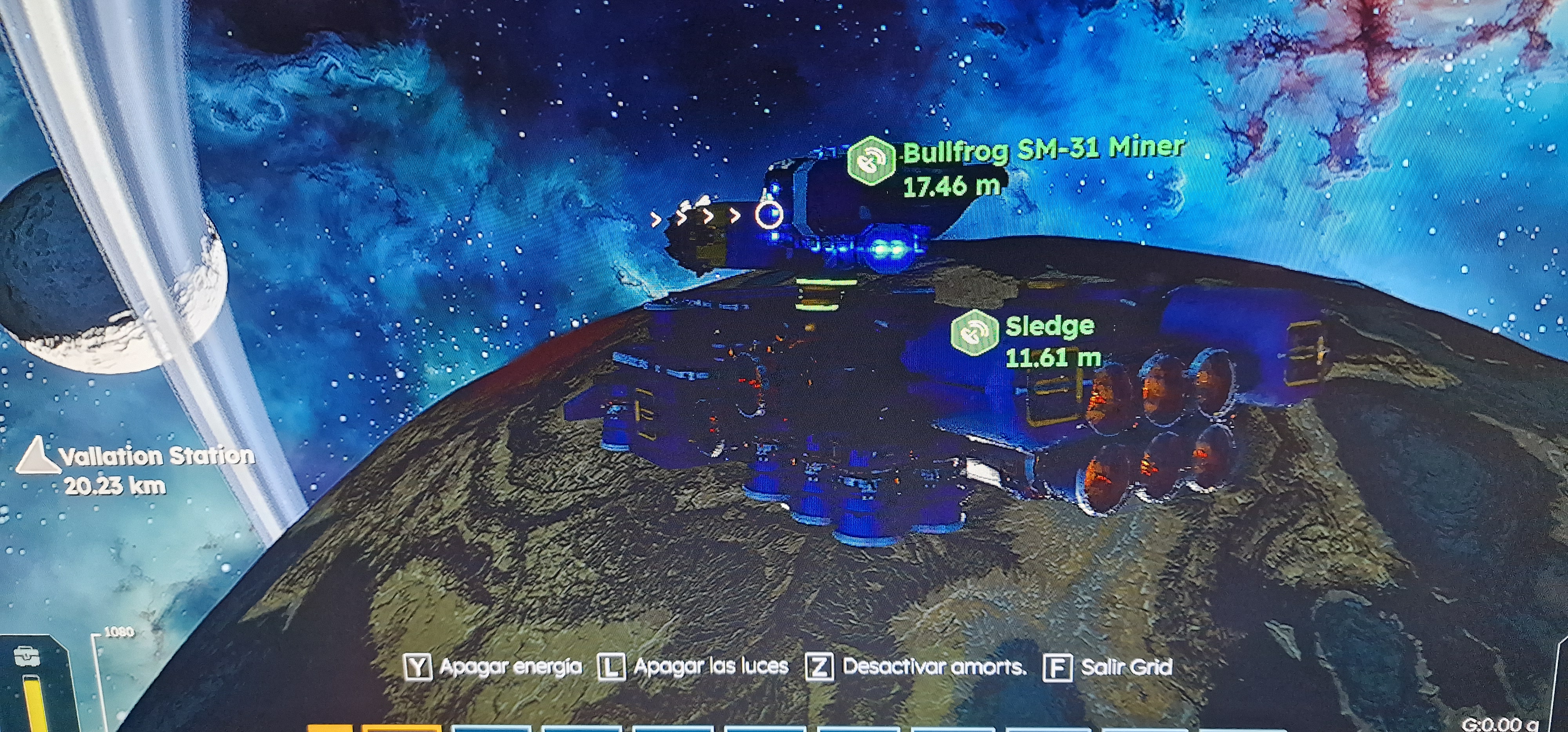
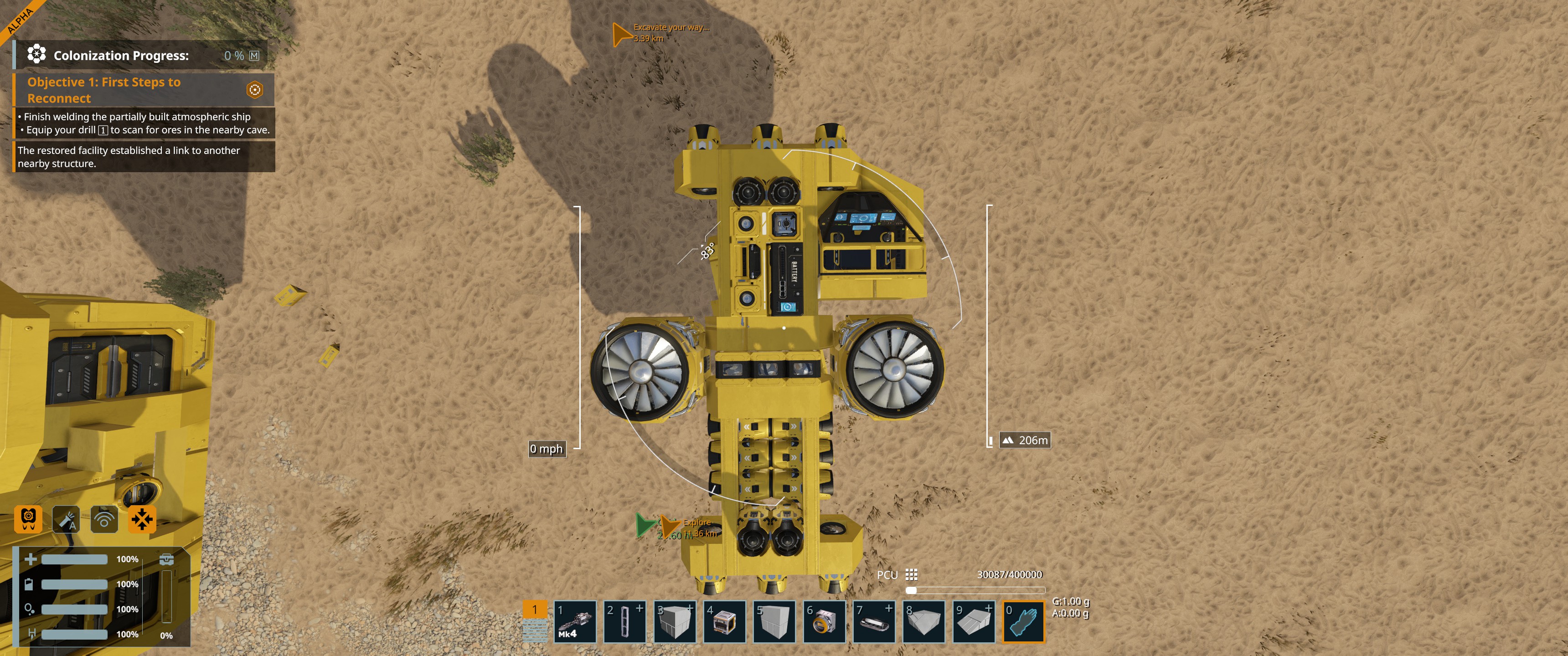
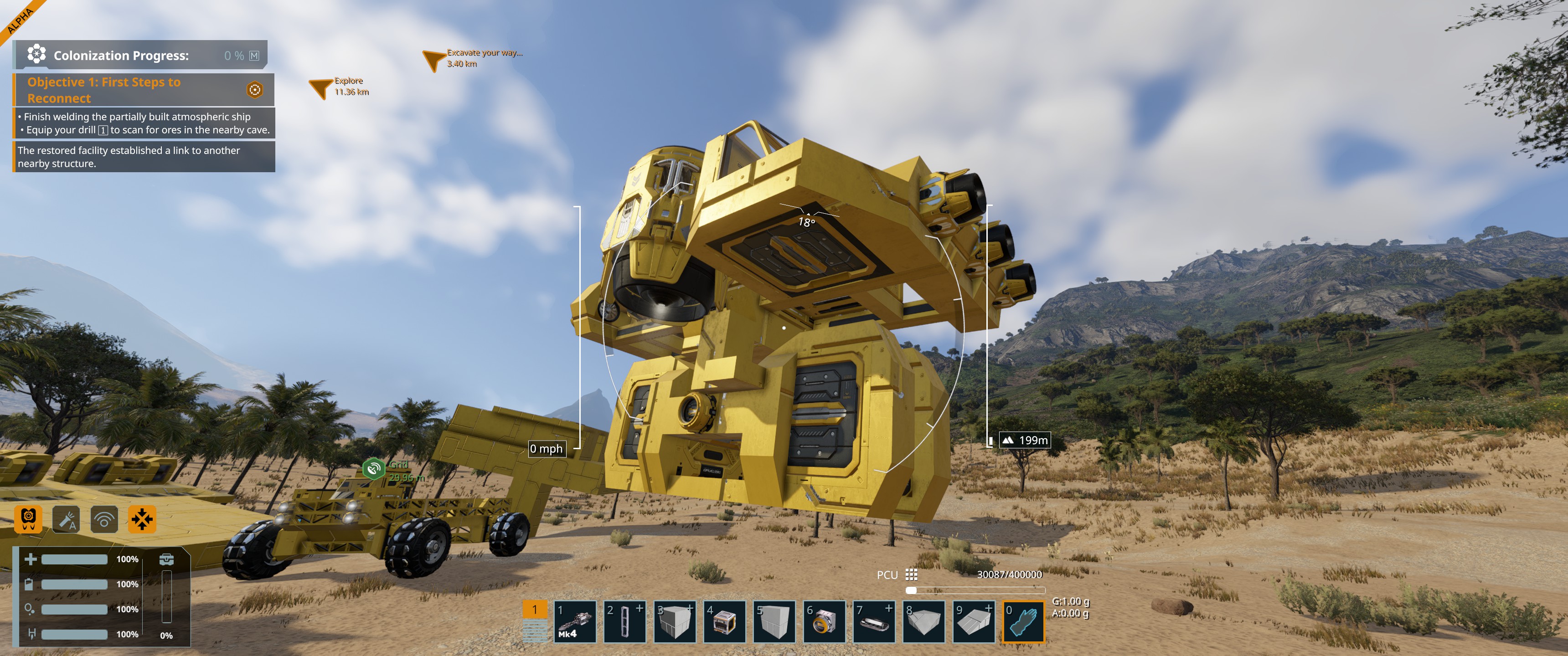
Welded up a copy of the bullfrog SM-31 and attached it to top of the Sledge. Every time I thrust forward or backward, the ship pivots up or down respectively so I cannot keep a bearing. Side or up/down thrust seems ok. If I sustain thrust the ship spins up or down and my view moves to a strange place in the cockpit. if I 'tap' the forward thrust and steer down, I can almost maintain bearing.

Flight Characteristics With Connected Mass
Reported
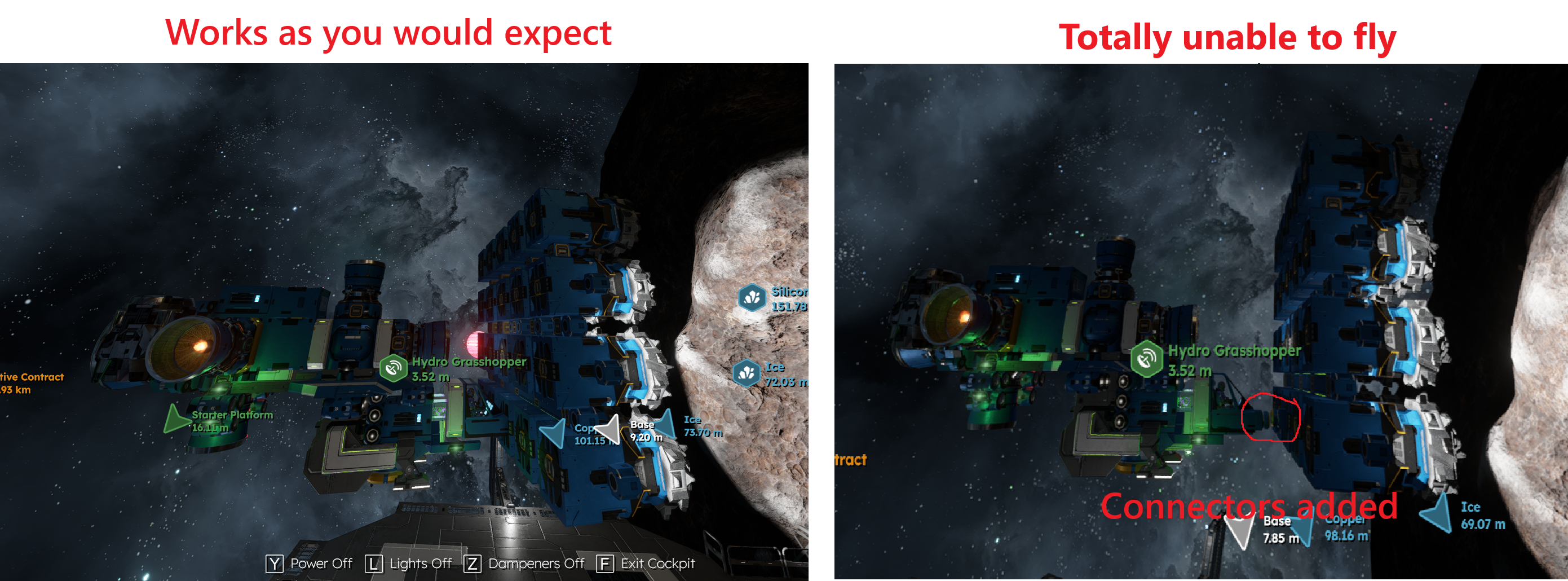
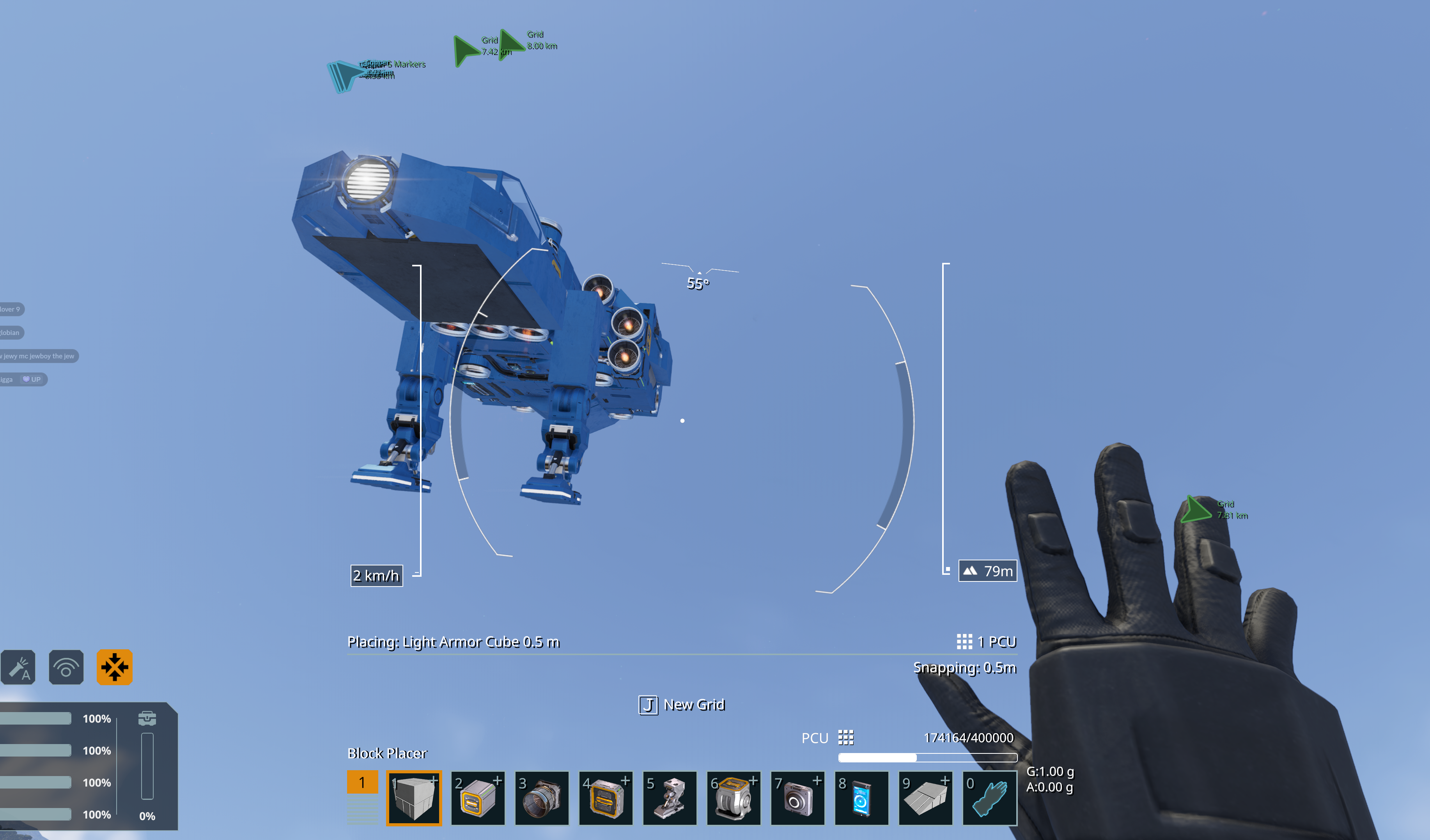
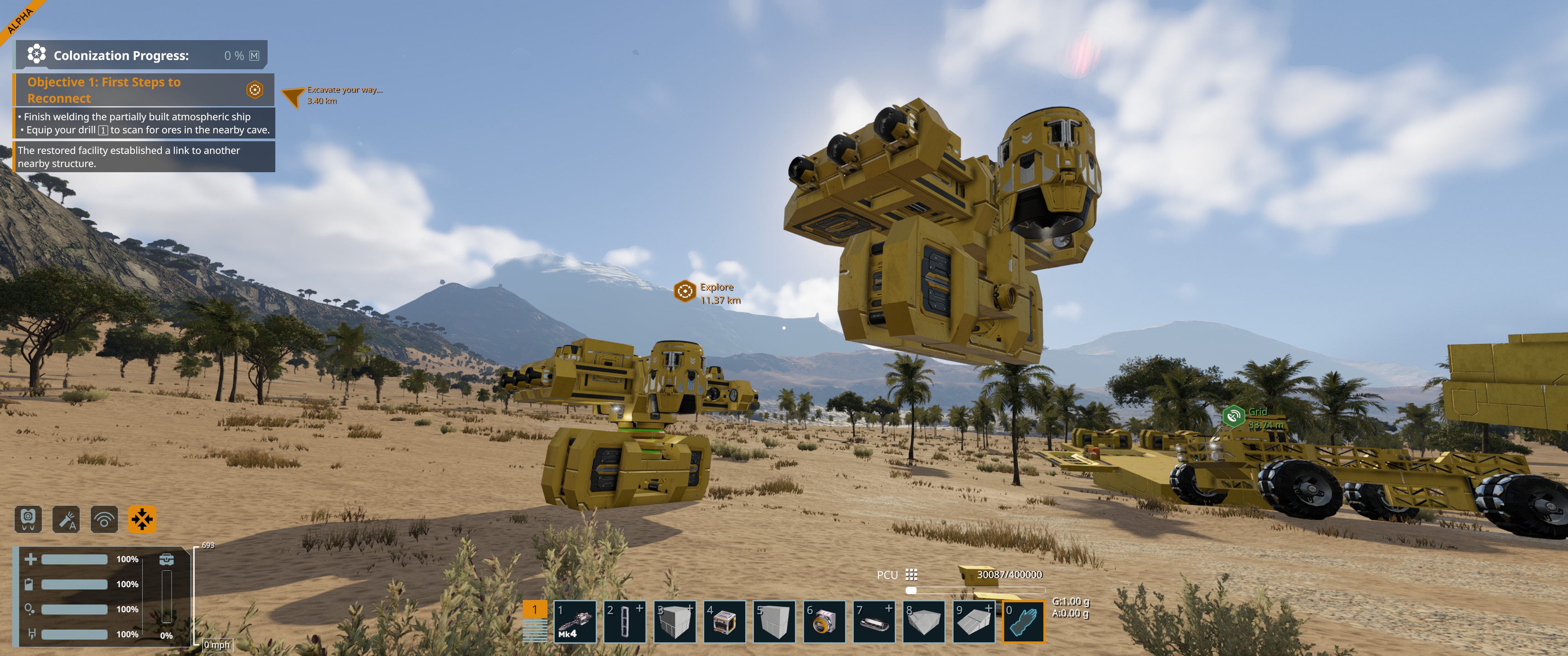
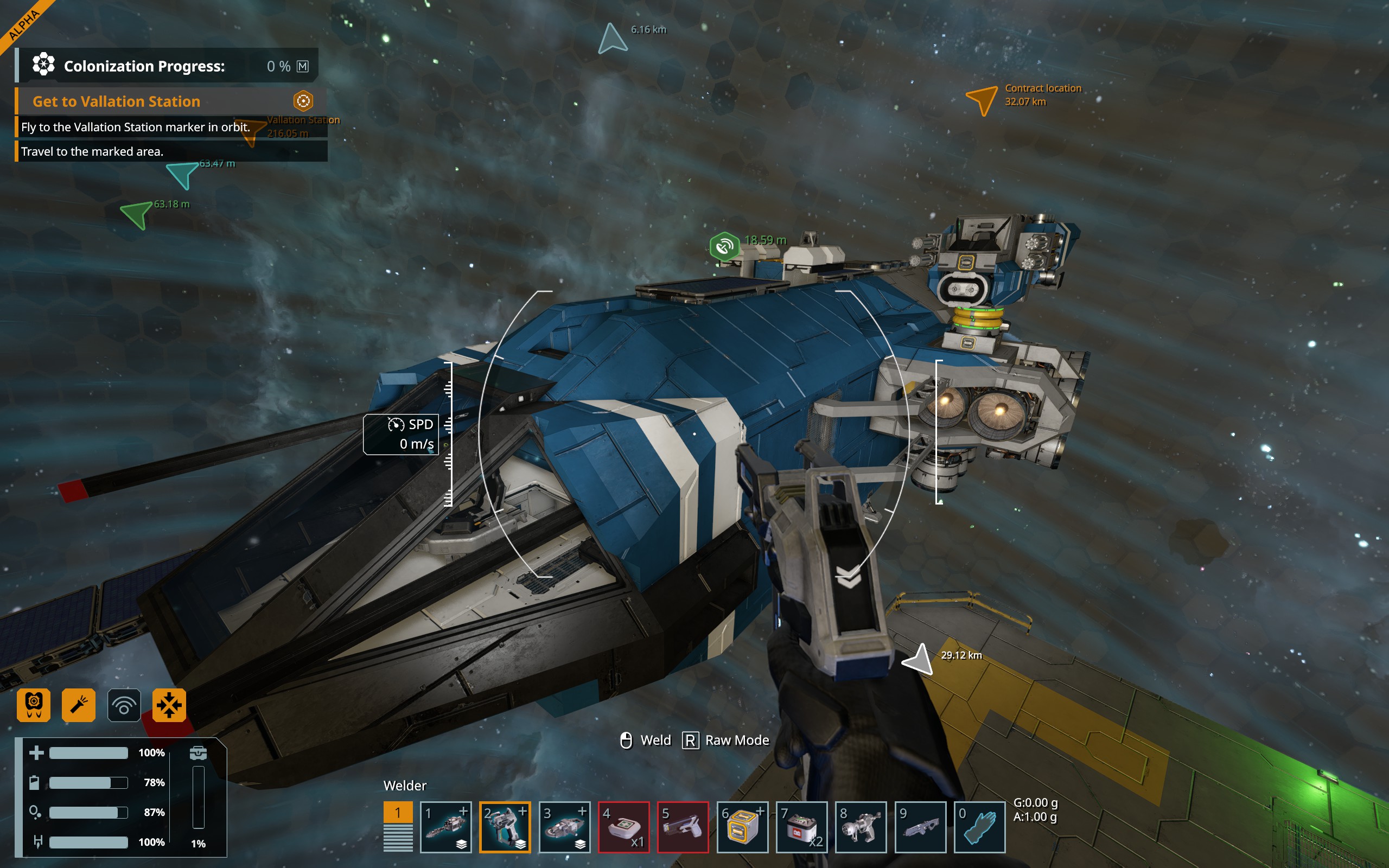
The Flight Characteristics when using a connector or landing gear to carry another grid seem to be very wrong once the mass of either becomes slightly larger then the 1 container used in the Contract. These two ships are the same except one has the drills connected via a connector and the other is just attached normally.
There does not seem to be a logical reason that one works and the other doesn't seeing as the game does not allow for the Thrust axis though any point except centre of mass. leaving no way to make detachable tool heads without the ship becoming unflyable.
Dampeners also don't seem to take into account connected mass via landing gear or connectors either so in gravity the ship slowly drifts downwards.
 I have the same bug
You can't vote. Please authorize!
You can't vote. Please authorize!
I turned off the gyros and thrusters on the attached miner, no difference. I reversed the direction of the miner, same effect. I grabbing the miner with the sledge instead of the other way around, same effect. Maybe this is expected from the new physics, but it seems strange.
I turned off the gyros and thrusters on the attached miner, no difference. I reversed the direction of the miner, same effect. I grabbing the miner with the sledge instead of the other way around, same effect. Maybe this is expected from the new physics, but it seems strange.
Towed the miner direcly behind the sledge and the steering was a little sluggish but it worked closer to how I'd expect it to behave. So maybe this is just the new physics.
Towed the miner direcly behind the sledge and the steering was a little sluggish but it worked closer to how I'd expect it to behave. So maybe this is just the new physics.
Nope. When get to 500 km/h forward, then turn on intertial dampeners, the ship spins like crazy. That should not happen since now the mass is linear it should have slowed linerarly.
Nope. When get to 500 km/h forward, then turn on intertial dampeners, the ship spins like crazy. That should not happen since now the mass is linear it should have slowed linerarly.
Few clips of Subgrids inducing torque onto the main grid which seems either wrong or a very large change from SE1.
https://www.youtube.com/watch?v=jxA0wEPWHHg
Few clips of Subgrids inducing torque onto the main grid which seems either wrong or a very large change from SE1.
https://www.youtube.com/watch?v=jxA0wEPWHHg
This is the same issue i'm having and attaching to ships is how i first noticed it.
It applies to Any mass connected via landing gear or connectors.
https://support.keenswh.com/spaceengineers2/pc/topic/51013-flight-characteristics-with-connected-mass
This is the same issue i'm having and attaching to ships is how i first noticed it.
It applies to Any mass connected via landing gear or connectors.
https://support.keenswh.com/spaceengineers2/pc/topic/51013-flight-characteristics-with-connected-mass
I have not tested with connector, but I experienced odd behaviour the same as this. Connecting one ship to another ship with landing gear caused this for me.
Shutting off all of the propulsion on the ship using the landing gears seems to reduce the effects slightly, but turning off gyros and propulsion on the ship being carried does not fix anything. Adding more gyros on the main ship seems to help, but I had to get to 9x 0.5m gyros to have the movement be slight which seems odd considering each ship only needs 2-3 on their own for stable flight. It only seems to affect trying to accelerate at that point. Strafing and accelerating backwards not noticeably affected with lots of gyros. Odd movement kicks in whenever forward thrusting kicks in, whether initiated by player or by dampening. By dampening I mean if I reverse thrust movement is normal, but as soon as I let off thrust and dampening kicks in the ship starts moving. That's all the testing I've done so far on it.
If you have a grid attached via connector the ship is pulling up / down on acceleration and breaking. Doesn't matter, if the gyro and dampeners of the connected craft are on or off. You can only move with short impulses and dampeners off, otherwise you loose control. In addition H2 seems to be used up quickly.
If a ship is connected via gear, this seems to apply only at breaking.
There also seems to be a slowing down of rotation even when a grid has no gyro built.
One of the tests I did was to power off the ship in the clip and it eventually stopped spinning.
None of the grids in the video have gyros yet they are still able to apply rotation.
I'm hopeful this is actually a bug and not a planned changed to the way flight works.
I have this problem even with one container in the Contract. With any subgrid attached, in gravity ship slowly drifts downwards.
The greater difference in mass between the grids, the faster they falls.
Same issue with dampers in SE1, but it appears randomly.
I have this problem even with one container in the Contract. With any subgrid attached, in gravity ship slowly drifts downwards.
The greater difference in mass between the grids, the faster they falls.
Same issue with dampers in SE1, but it appears randomly.
I think this is no bug, but a physically correct behavior. This is how mass with non centric thrust behaves in space. (it's about innertia). I remember, when SE1 had the same issue. It is correct, but not fun to play. We are not actual rocket scientists.
SE1 was fixed by combining the centers of mass of both connected grids. I hope the devs will fix this in the next update.
Hello Engineers,
This is a known issue that is already reported internally. I have added this thread to our internal ticket (SE2-29691).
Kind Regards,
Bartosz
Keen Software House
Hello Engineers,
This is a known issue that is already reported internally. I have added this thread to our internal ticket (SE2-29691).
Kind Regards,
Bartosz
Keen Software House
This happened to me aswell with 2 smaller ships but the "carrier" was at least double the size. But the carrier was Hydrogen Thrusters and the Miner was Ions.
It was worse if the carried ship had it's dampeners on.
A tiny difference if the carried ship was totally powered down, but just so you could tap up the speed and tap slow down.
I find that acceleration kind of works, but as soon as you let go of W to start slowing down, you get a massive attitude shift - as in near immediate 90+ degrees in some direction.. doesn't matter if the piggy-backed ship is powered or unpowered either. This felt a little better pre VS2.2. Kind of guessing this is maybe connected to some physics changes to the docking behaviour, that also became more violently 'jerky' in VS2.2, and has no problems shoving rather large ships around like they had no mass.. The dampened flight mechanics in general are, well, in need of work, but I agree with the OP, this is problematic. It's still kind of flyable, but it's a massive pain.
I find that acceleration kind of works, but as soon as you let go of W to start slowing down, you get a massive attitude shift - as in near immediate 90+ degrees in some direction.. doesn't matter if the piggy-backed ship is powered or unpowered either. This felt a little better pre VS2.2. Kind of guessing this is maybe connected to some physics changes to the docking behaviour, that also became more violently 'jerky' in VS2.2, and has no problems shoving rather large ships around like they had no mass.. The dampened flight mechanics in general are, well, in need of work, but I agree with the OP, this is problematic. It's still kind of flyable, but it's a massive pain.
Hello Engineers,
I wanted to give you all a quick heads up. Since release of VS2.2. Rotors and Pistons are also affected by this issue causing instabilities in flight characteristics. We are still working on solution for this issue and I don't have any ETA at the moment unfortunately.
Kind Regards,
Bartosz
Keen Software House
hhmm... a KSP command of 'control from here' would be helpful, it took all subgrids and grids connected and temporarily aligned their controls to the selected control block, based around a unified CG. Could align phantom forces/CG differences/dampers behavior, not sure for the SE2 landing gear logic, maybe could work for a temporary CG alignment.
hhmm... a KSP command of 'control from here' would be helpful, it took all subgrids and grids connected and temporarily aligned their controls to the selected control block, based around a unified CG. Could align phantom forces/CG differences/dampers behavior, not sure for the SE2 landing gear logic, maybe could work for a temporary CG alignment.
I’ve also had this weird affected flying behaviour affect me today. I have a grinder on the end of a piston on my ship. It’s virtually unflyable. Acts like it’s tipping forwards. Also my ship gets damaged under acceleration and deceleration. Loud crunching noises 😩
Anyway, just wanted to add my name to the list. Thanks for the update Bart. Hopefully it can be fixed soon 👍
Have the same. While having a heavier 'tug' ship, with a lot of gyros and turning the towed ship off helps, it's still pretty bad. We are still unable to pickup an empty Grasshopper with an empty Sledge and move it between platforms without almost flipping the Sledge.
Have the same. While having a heavier 'tug' ship, with a lot of gyros and turning the towed ship off helps, it's still pretty bad. We are still unable to pickup an empty Grasshopper with an empty Sledge and move it between platforms without almost flipping the Sledge.
two ships the same size or a carrier and a miner(or whatever kind of small ship) docked should fly straight in space or atmosphere.
the ship wants to rotate the direction of the connector as if the connector is a giant mass pulling it down.
two ships the same size or a carrier and a miner(or whatever kind of small ship) docked should fly straight in space or atmosphere.
the ship wants to rotate the direction of the connector as if the connector is a giant mass pulling it down.
Ship has no inertia dampener down thrust | Space Engineers 2 Support
Ship has no inertia dampener down thrust | Space Engineers 2 Support
I encountered the same problem, and in addition the ship is very difficult to fly and is very unbalanced. The thrust seems to be applied to the center of mass of the ship only (without subgrids).
I encountered the same problem, and in addition the ship is very difficult to fly and is very unbalanced. The thrust seems to be applied to the center of mass of the ship only (without subgrids).
This is the same in space. It shouldn't matter how a subgrid is attached, as long as the thrust is applied evenly to a grid regardless of actual thruster placement. If you magnetically, landing gear or connector connect a subgrid to a ship, it's mass should accelerate and turn as though it's a part of the main grid. If they implement unbalanced thrust where you need to place thrust in the center of mass to accelerate in a straight line, then subgrids certainly should be calculated in that.
This is the same in space. It shouldn't matter how a subgrid is attached, as long as the thrust is applied evenly to a grid regardless of actual thruster placement. If you magnetically, landing gear or connector connect a subgrid to a ship, it's mass should accelerate and turn as though it's a part of the main grid. If they implement unbalanced thrust where you need to place thrust in the center of mass to accelerate in a straight line, then subgrids certainly should be calculated in that.
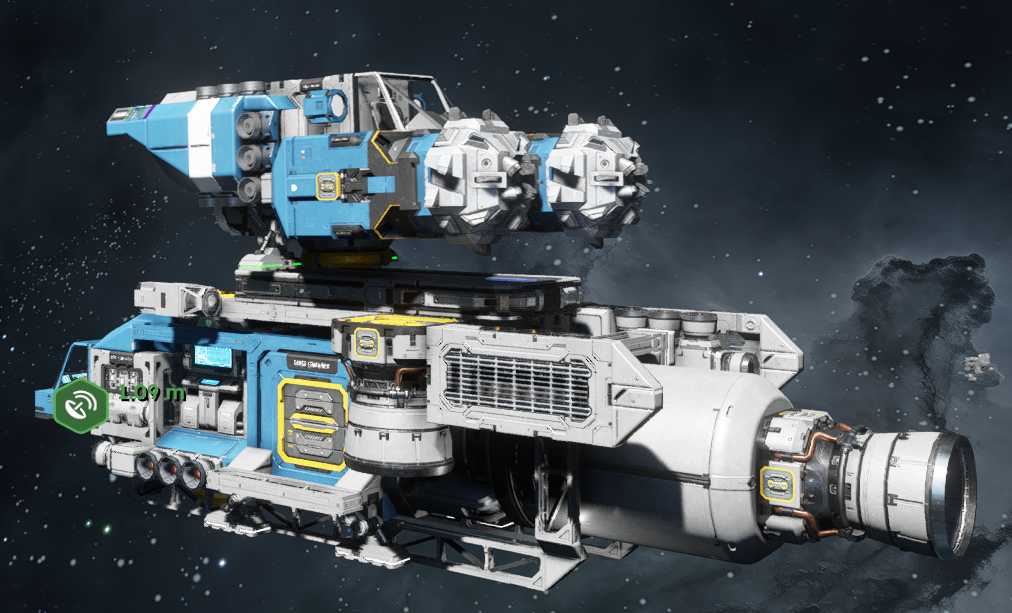
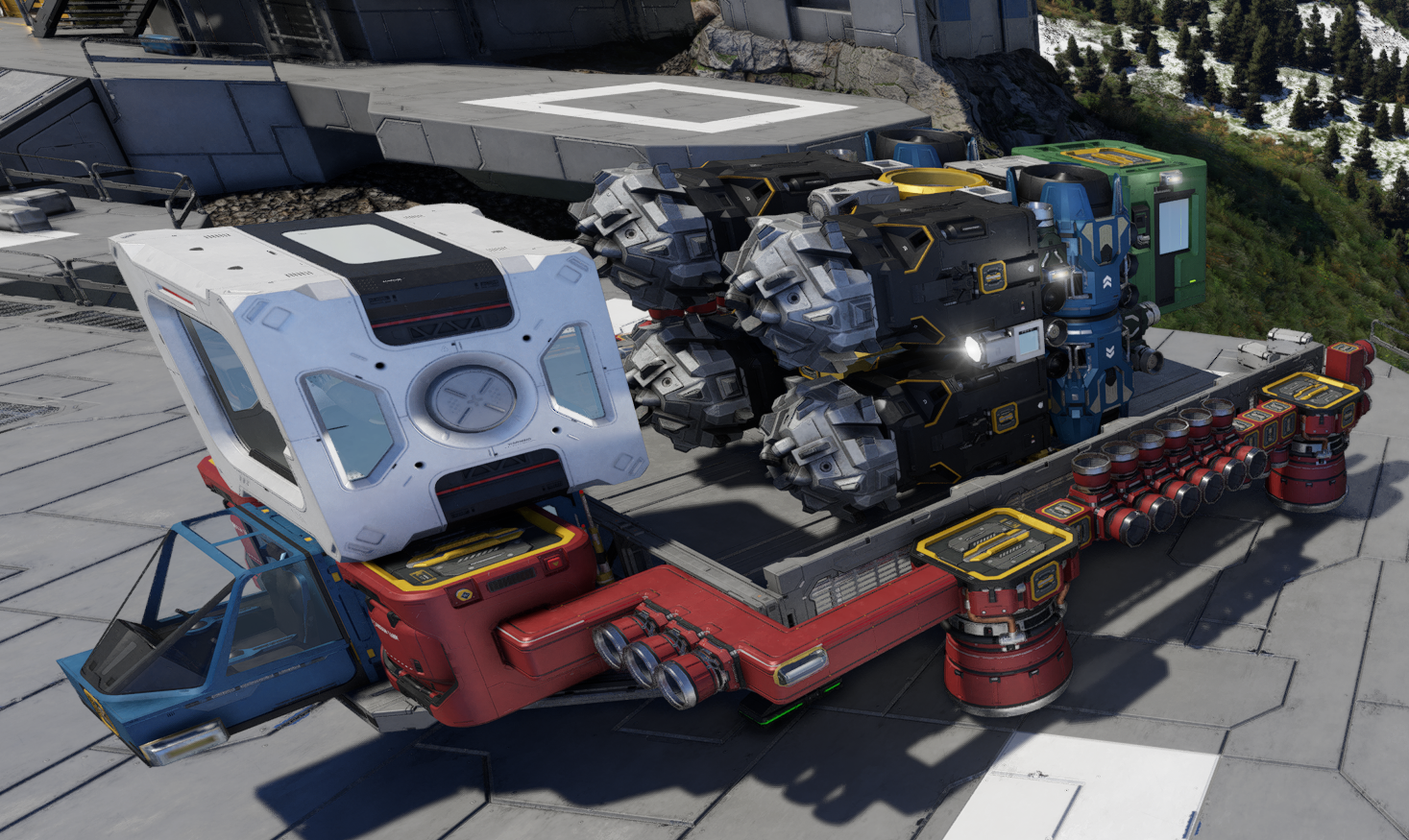
The ship I was testing was my vertical miner (see attached image). Since the rotating part with the drills is at a great distance from the ship center, the ship is barely flyable.
The ship I was testing was my vertical miner (see attached image). Since the rotating part with the drills is at a great distance from the ship center, the ship is barely flyable.
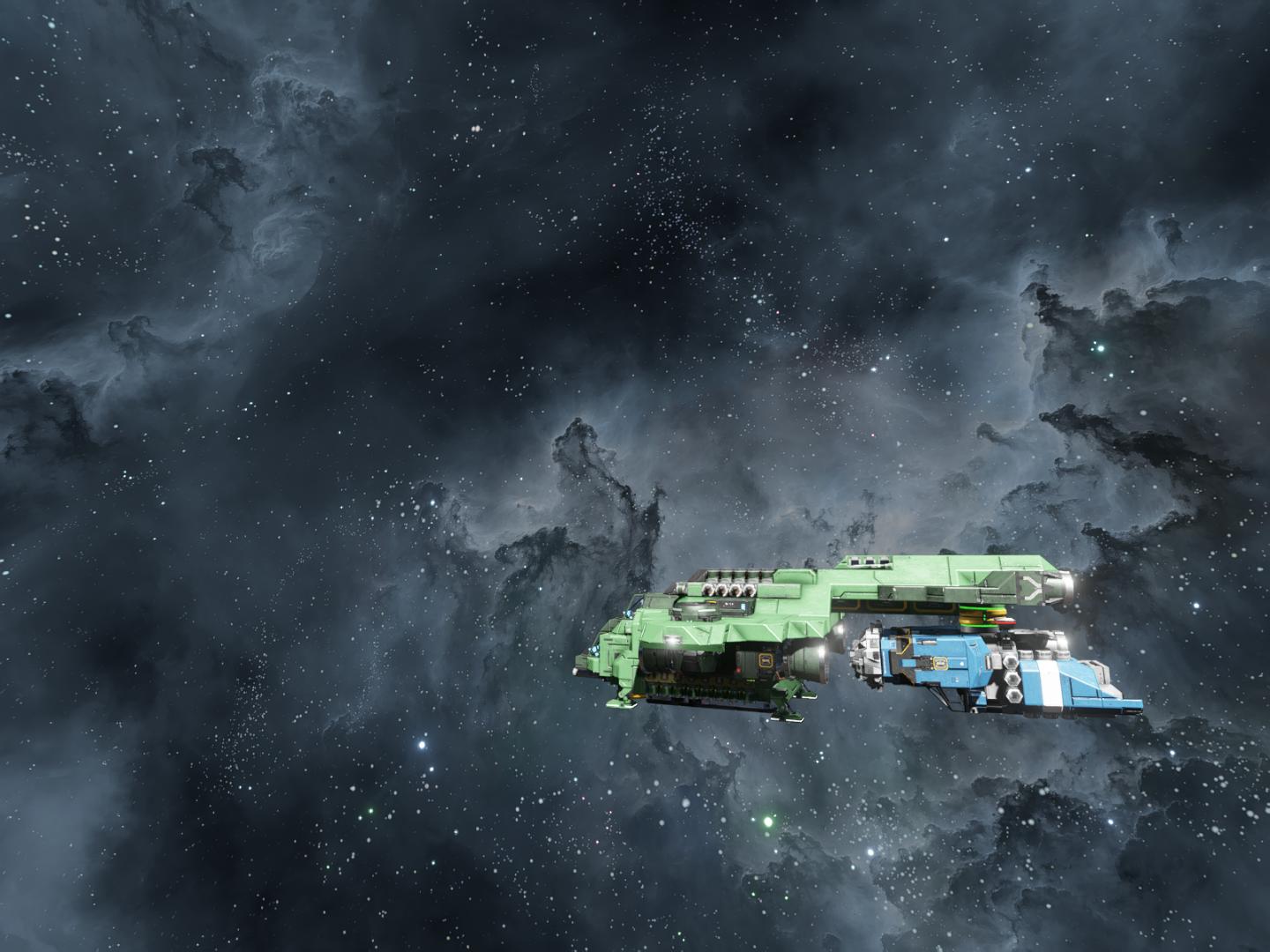
For example.
Both docked ships have inercial dampers off, the fly is stable, until i release the w key and stop to accelerate.
For example.
Both docked ships have inercial dampers off, the fly is stable, until i release the w key and stop to accelerate.
i think it's a need to balance the position of thruster with the center of global mass, and their power, but not a real issue.
I had the same "bug", but it's fixed when i build bigger gyro.
i think it's a need to balance the position of thruster with the center of global mass, and their power, but not a real issue.
I had the same "bug", but it's fixed when i build bigger gyro.
I'll try adding more or larger gyroscopes, but simply stopping the acceleration without touching anything shouldn't produce such a strong turning force.
I'll try adding more or larger gyroscopes, but simply stopping the acceleration without touching anything shouldn't produce such a strong turning force.
Hello Luis Diaz Alejo,
Does this issue occurs also when the additional ships are not connected? Could you please provide a video recording?
Kind Regards,
Bartosz
Keen Software House
Hello Luis Diaz Alejo,
Does this issue occurs also when the additional ships are not connected? Could you please provide a video recording?
Kind Regards,
Bartosz
Keen Software House
Hi, I tried landing on a planet to record the video, but the other, more serious bug that prevents you from controlling your ship when another ship is docked is stopping me. I'm going to try landing without any ships and building one on the ground.
The bug of lossing alttitude only occurs when a ship is docked.
When i have the video, i upload it.
Hello ryan,
This is a known issue related to subgrids. Please note that since you are in planetary gravity, you will be moving however in space, the Grid should not move. You can somewhat alleviate this by making your Grid much heavier than the subgrid.
As such I will merge this thread with the main thread.
Kind Regards,
Bartosz
Keen Software House
Still not fixed in VS 2.3
Still not fixed in VS 2.3
When 3 drills are attached to the front of a grid using a Rotor, the ship is completely unable to pitch up (lift its nose) while on the ground. However, when the exact same 3 drills are attached directly (hard-mounted without a rotor), the ship pitches up and takes off without any issues.
When 3 drills are attached to the front of a grid using a Rotor, the ship is completely unable to pitch up (lift its nose) while on the ground. However, when the exact same 3 drills are attached directly (hard-mounted without a rotor), the ship pitches up and takes off without any issues.
For devs : just go there, and try the ship in workshop, see how it fly correctly without connected/transported vehicle, and show how it is impossible to fly with it ( with 2 drill tools please XD).
https://steamcommunity.com/app/1133870/discussions/0/592939030339990118/
For devs : just go there, and try the ship in workshop, see how it fly correctly without connected/transported vehicle, and show how it is impossible to fly with it ( with 2 drill tools please XD).
https://steamcommunity.com/app/1133870/discussions/0/592939030339990118/
I have this too and I have spent several hours trying to figure out why it is doing this. Things I checked, orientation of the gyro, orientation of the survival kit, rebuilt the connectors. Checked all settings, turned off target based gyro which didnt change anything. Im not sure what else to do. I have checked other ships as well and also used different ships to attach to Aquila. Everything else works as expected. Something in Aquila is bugged.
I have this too and I have spent several hours trying to figure out why it is doing this. Things I checked, orientation of the gyro, orientation of the survival kit, rebuilt the connectors. Checked all settings, turned off target based gyro which didnt change anything. Im not sure what else to do. I have checked other ships as well and also used different ships to attach to Aquila. Everything else works as expected. Something in Aquila is bugged.
It's hard to transport smaller ships in general at SE2.
I'm doing Every time:
1) small ship is pulling big one in direction where it really located, so perfect location of small ship is behind or inside the big one (not at a side)
2) every time before starting - turn off Gyro and Engines of small ship
Rare exception if you are pulling the big Renegade ship - it is more stable with Gyro turned on at both (but will be harder to turn)
3) transfer ALL cargo from small ship to big one, the total weight really matters
4) and the last but important - big one should be Much heavier than small one by weight, not by size - Aquila is empty and not heavy
I think you should have 10-15 small Gyro on Aquila for comfortable flight with small ship, you can disable some Gyros when small will fly away.
The situation which you describe about firing Engines at attempt a turn - it's correct.
Lightweight Aquila is counting a "small" ship as an anchor - trying to turn, by weight logic, Aquila is moving around an anchor - engines are trying to compensate that movement. So it's not using engines to fly, it's using engines to stop your turn.
Same time - position of small ship is 100% wrong, it's an anchor at the side of a ship.
Even with exactly the same weights and power, if you will locate small ship perfectly behind the Aquila (where the rear engine by default) - it will act differently.
Or ignore location and weight and build 30 small Gyros at Aquila - they will compensate rotation around anchor, and engines will be relaxed.
I have this same bug in space and in my head this should not happen in space where there is no gravity. I could see this or something similar happening on the planet in gravity though. Again, it doesn't feel right that this is the behavior in a zero gravity environment.
I have this same bug in space and in my head this should not happen in space where there is no gravity. I could see this or something similar happening on the planet in gravity though. Again, it doesn't feel right that this is the behavior in a zero gravity environment.
It's not about gravity or 0 gravity, it's more about Newton's law - if you pull it, it pulls you back in the direction of where it is attached. Same time it could be even more notisable in space, while there are no other forces which can compensate the force of small ship pulling you back.
Just watch a movies like "Gravity" - there are a lot of moments in space where even a small forces start extremely turning, pulling the actors or their ships flying in space.
Desctiption of This movie in wikipedia:
1. Since the impacts do not strike the center of mass of the stations but rather hit tangentially, the structures are instantly sent spinning along all axes.
2. Absence of air resistance: In the vacuum of space, there is no atmosphere to slow down or stabilize rotation through friction. Any rotational momentum gained is conserved, causing the modules to spin indefinitely until acted upon by another external force.
In case of SE2 - Engines are trying to stop the turn ;) Or you should use a lot of Gyros at main ship.
While I understand the physics of thrust that isn't applied through the center of mass, the magnitude of the reaction seems excessive. One possible reason for this is that thrusters are either ON or OFF, with no partial thrust. Because of that a small off-axis thrust ends up creating a much more severe reaction as ALL engines used to counter the motion go to full thrust.
This seems to be an over-reaction from the dampeners related to direction changes. I can fly with an off-center mass attached just fine with dampeners on as long as I don't change directions at all. I can go forward/backward/left/right/up/down and ship doesn't turn at all (even with off-center mass) but simply turn on dampeners and the ship makes extreme corrections.
In addition, when in space when ship is at 0 relative motion simply turning the ship with gyros creates the same excessive reactions while turning off dampeners makes the ship move as if nothing is attached. I'm able to carry smaller craft by turning the ship with dampeners off and then turning dampeners ON and moving with just thrusters.
I like that there should be some effect from off-center thrust, but the current effects don't feel realistic at all.
Lastly, we can't claim that the physics are at all realistic when ships don't change heading even with thrusters not centered around the center of mass. Look at the Aquila (new survival game starting ship) and it's upward facing thrusters. In space, if I move the ship "down" using the 'C' key I should see ship rotation (nose up). Ship's gyroscope could be countering that off-center thrust, but then the ship's gyroscope *should* be doing the same when a new mass is added.
A small ship (about 11 tons) docked via a connector to a larger ship (about 213 tons) and completely turned off (Y) leads to very erratic behaviour on the large ship — it shows a weird phantom ~2MW electricity draw (completely gone with the small ship disconnected) that I could not trace to any particular blocks in control panel, and simply rotating with the mouse fires the large ship's thrusters in seemingly random directions even though rotation should be gyro only; it does not seem to be compensating for anything because the firing thrusters actually propel the ship in unexpected directions, making it very difficult to control safely.
A small ship (about 11 tons) docked via a connector to a larger ship (about 213 tons) and completely turned off (Y) leads to very erratic behaviour on the large ship — it shows a weird phantom ~2MW electricity draw (completely gone with the small ship disconnected) that I could not trace to any particular blocks in control panel, and simply rotating with the mouse fires the large ship's thrusters in seemingly random directions even though rotation should be gyro only; it does not seem to be compensating for anything because the firing thrusters actually propel the ship in unexpected directions, making it very difficult to control safely.
we should pile up there https://support.keenswh.com/spaceengineers2/pc/topic/51013-flight-characteristics-with-connected-mass
we should pile up there https://support.keenswh.com/spaceengineers2/pc/topic/51013-flight-characteristics-with-connected-mass
AH. so thats what does it. I also have this issue. I found turning inertial dampers off will make this issue go away. something weird between being docked and that. I also always turn my dampers off on my docked ship.
AH. so thats what does it. I also have this issue. I found turning inertial dampers off will make this issue go away. something weird between being docked and that. I also always turn my dampers off on my docked ship.
Empty out the docked ship—don't leave anything in its cargo hold or any other inventory—and then you should be able to fly it.
This is definitely something that still needs to be reworked; it doesn't just happen with the Aquilla.
Empty out the docked ship—don't leave anything in its cargo hold or any other inventory—and then you should be able to fly it.
This is definitely something that still needs to be reworked; it doesn't just happen with the Aquilla.
I have this same issue with Aquila, with a small miner attached to it by the miner's landing gear. It's happening since the last update. Aquila fires off directional thrusters in one axis when rotating the ship with mouse. I have to make turns with dampeners off just so Aquila doesn't take off in a random direction at 80 m/s. There's one 2,5 m gyro on Aquila, built like the datapads suggested.
I have this same issue with Aquila, with a small miner attached to it by the miner's landing gear. It's happening since the last update. Aquila fires off directional thrusters in one axis when rotating the ship with mouse. I have to make turns with dampeners off just so Aquila doesn't take off in a random direction at 80 m/s. There's one 2,5 m gyro on Aquila, built like the datapads suggested.
Just confirming this, seems like dampeners are over reacting when 2 ships are attached.
Just confirming this, seems like dampeners are over reacting when 2 ships are attached.
Having similar issues as well:
The instant hydrogen tanks drain when idling and with multiple grids connected together (with multiple hydrogen thrusters on carrier). Looks like the there is issue with inertia dampeners.
Even with all other grids powered off there is still quite drain.
Like something is calculating thrusters on 100% override to all directions when there is no carrier movement.
It also seems same situation on electrical blocks as well on idle.
Replies have been locked on this page!