


Grid Takeover / Hacking
In SE1, if you wanted to take over a ship, you basically had to grind down half of the functional blocks below the hacking line and weld them back up again. In practice, this is extremely impractical. I understand that stealing someone's ship should not be trivial, but this system feels like way too much work for what you get out of it. In many cases, it's simply more efficient to grind down the entire ship and take the components rather than trying to hack and capture it.
There is also another detail: the ability to control a grid is strictly tied to ownership.
You can have a completely accessible cockpit or an open-style rover, yet you still can't sit in the control seat and drive it because you don't own the grid. It's basically password-locking the seat by default for no good reason.
I think we should separate controlling a grid from taking ownership of a grid.
Controlling a grid
You should be able to sit in a working control seat even if you don't own the grid or have it shared.
If nobody else is currently controlling the grid, you can use that control seat to pilot, drive, steer or otherwise operate the grid.
If the actual owner sits in another control seat afterwards, they take control back.
This does not mean you have taken ownership of the grid. You still don't own any of its blocks.
For example:
- Turrets would not suddenly recognize you as friendly and start following your enemies.
- But you could fire fixed weapons if they are selectable through the control seat's toolbar.
- You couldn't open locked cockpits or other inaccessible interiors.
- You could use an open rover seat, ship control seat, etc. if you can physically reach it.
- You could fly, drive, or dive the grid as long as there isn't already another pilot controlling it.
The same principle should apply to normal cargo containers.
If I'm literally standing in front of a normal cargo container, why can't I open it and take something out just because I don't own the grid?
I understand this for special containers like armored ammo magazines, secure lockers, etc. But a normal cargo container should be physically accessible if I can reach it. And ofc, this doesn't mean I automatically get access to every inventory connected to it. I should only be able to access what's physically in that container.
So taking control over a grid is possible while ownership remains unchanged. This can be useful for many reasons. Sometimes you just want anyone to use a parked rover without bothering to set up detailed permissions. And it ofc open up interesting scenarios. Stealing grids will become actually possible. So don't let any strangers to get on board or at least close the doors to where control seat are. Missions where you need to steal something or just being able to quickly escape by using one the locally parked grids.
Proper grid takeover / hacking
So, if controlling a grid is no longer tied directly to ownership, what about actually taking over the grid?
I think this should be something relatively simple, but still difficult enough that it can't be exploited or executed too fast.
You would need:
- Access to several functional block control panels on the grid.
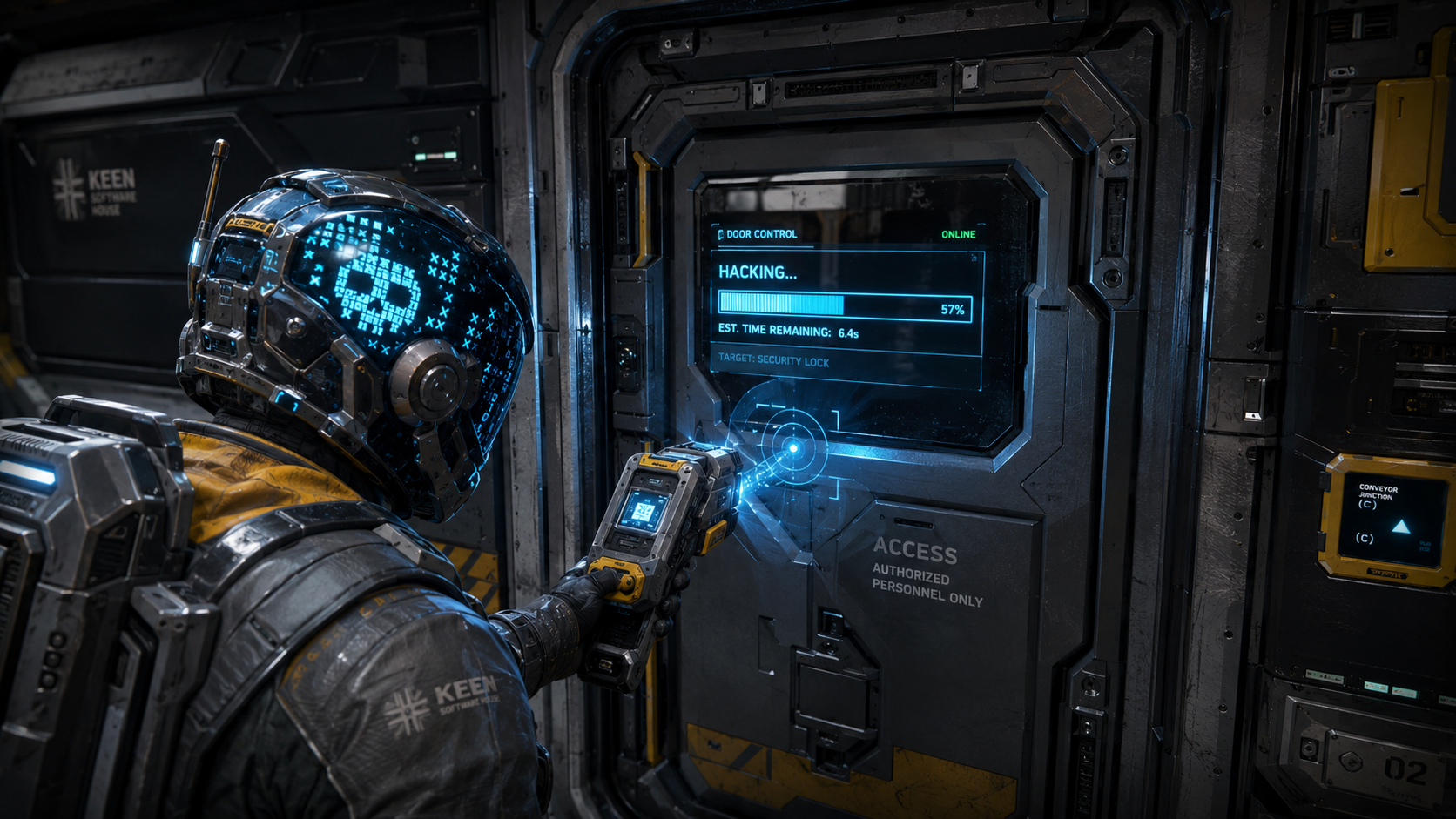
- A hand held hacking terminal tool.
- Hack a certain number of blocks
Certain functional blocks would count as hackable, for example:
- Control seats
- Reactors
- Batteries
- Event Controllers
- Production blocks
- Other important functional blocks
- Doors*
Weapons like turrets are not hackable.
The number of blocks you need to hack start with 1/4 of the total hackable blocks on the grid, as an example.
If you are using higher hacking tool tier you will reduce that count quicker. For example, tier 3 hacking terminal will decrease the count by 3 after each successful block hack.
* Doors are excluded from the block count you need to hack, you can only hack them to get control and open.
Hacking shouldn't be instant. The time could be comparable to completely grinding down the block with a hand grinder, multiplied by some factor.
This creates an interesting strategic choice. You can look for relatively light/easy blocks to hack and speed up the process, except if you intentionally want to take over on something like large nuclear reactor to shut it down.
And there is one important rule:
You cannot completely take over a ship while its owner is still on the grid or connected grids (like a ship docked to the station and the owner is sitting somewhere on the station or other docked ship). You need to get rid of the owner first. After that, you still need to hack one additional block, even if you had already hacked enough blocks before the owner left/died.
This prevents exploits when a sneaky hacker tries to get ownership of the grid right under the nose. Moreover, you can setup event controllers to listen for hacking attack and make a sound block announce how many blocks remain or play any alarm, activate some of the antihacking measures, like some additional traps or "surprise" turrets or what ever you can come up with to slow attackers down.
Firewall block
If you want additional protection, there could be a dedicated Firewall block. The Firewall increases the number of blocks that need to be hacked before the grid can be taken over.For example, it could make the requirement 3x higher. On the other hand, If you find and successfully hack the Firewall itself, it counts as 3 hacked blocks.
The Firewall would also be expensive and have a substantial PCU cost, so you wouldn't put one on every little grid. It would mainly be used to protect your most valuable ships and bases.
NPCs could use them too. Some NPC ships might have one, while others don't.
When you open the hacking terminal of a block you've already hacked, it could show you the remaining hacking count.
From that number, you can also potentially deduce that there is a Firewall somewhere on the grid.
You could install multiple Firewalls, but only one would actually have an effect. This prevents stacking them for absurd levels of protection.
Firewall block also make it impossible to control the grid you don't own.
What does this mean for ship design?
This could actually make hacking an important part of engineering your ship.
If you are worried about someone boarding and hacking your grid, you would want to:
- Protect your important functional blocks.
- Spread functional blocks across different rooms.
- Avoid exposing control panels directly to the outside.
- Separate critical systems behind doors and armor.
- Make the hacker move through the ship before reaching enough hackable blocks.
You could even create fake "control rooms" as traps.
Put a sign saying CONTROL ROOM, make it look important, and put absolutely nothing useful inside except an interior turret waiting for the poor bastard who enters. :)
Even if doors don't count toward grid takeover, I would make them easier to hack than grinding through blocks.
This would encourage attackers to actually infiltrate the ship rather than just standing outside and grinding through its hull.
Another, even simpler solution would be to make grinding enemy blocks much slower.
No more hydroman :)
A hand grinder would then be almost useless for breaking into an enemy ship. You would invest in a proper hacking terminal if you actually want to infiltrate and capture grids.
Grinding 2.5m heavy armor or concrete blocks with a hand grinder should basically be impossible or take an absurd amount of time.
That also creates some interesting defensive engineering possibilities. You could build mechanical systems that cover entrances with heavy blocks and effectively seal the ship during combat.
Of course, one can also put many functional blocks inside an armored chamber of heavy armor and thus make hacking very difficult. This is ofc a designer's choice. We can't do much about it except the fact that there will still probably be enough of the functional blocks scattered around the ship that you can easily cover or, if you do, you will probably make your everyday life using the grid much harder. Providing there is a firewall, and you are using the best hacking tool, their effects cancel each other. Therefore, you have to hack 1/4 (maybe 1/5) of all eligible hacking blocks, maybe doors should count too. In any case, if you allow hackers to deal with the ship for long enough, they will eventually take it over.
Final Thoughs
I think this system would give us a much better distinction between access, control and ownership.
You don't need to magically own a grid just because you sat in its driver's seat. And you shouldn't need to grind half of a perfectly functional ship and rebuild it just to make it yours.
At the same time, actually taking over a valuable ship remains a significant achievement that requires preparation, infiltration skills and patience.
I'll link some similar topics on this support site below. They contain a lot of useful details that could easily apply here instead of repeating the same information. Unfortunately, they're all archived now.
Thx for reading.
 I like this feedback
Another, simpler and more refined approach to hacking
For simplicity, grid ownership could again be determined by the number of owned functional blocks. Whoever owns more than 50% is considered the grid owner. This is formal ownership and nothing more. Being able to control the grid is still determined by the same factors as I have described before.
Once you control more than 50% of the functional blocks, you can start a 15-minute takeover timer from the Grid Terminal to convert the remaining blocks. If you lose majority control, the timer stops and has to start over. This gives defenders a chance to counterattack or call reinforcements, while the attacker has to actually hold the ship for a while before getting full ownership.
Hacking individual blocks is tedious. Same as we have single block welder and are welder, there can be 2 different tools for hacking (or you may alike having one tool and left click and right click modes). Higher-tier tools are faster, while a Firewall reduces hacking speed. If you find the Firewall, you can grind it down to remove the effect. Simple as that.
Area hacking is slower, but can hack many blocks at once, so the best approach depends on the situation. If there are only a few functional blocks nearby, single hacking might be faster. If you enter a room packed with Event Controllers, Timers, etc., area hacking becomes much more efficient. You could, for example, single-hack a door to get inside and then area-hack a whole rack of functional blocks.
This also makes hacking a natural part of boarding operations. You first fight your way to the bridge/control room and clear the crew, then calmly explore the ship and decide how to hack it most efficiently. You might look for the Firewall first and identify areas with many functional blocks clustered together. You could even learn the layouts of NPC ships and know where their Firewall is located. This makes hacking an actual skill rather than just grinding blocks one by one. It also solves the issue of hiding functional blocks inside armored cages. You will still reach them behind the walls now with area hacking.
The Grid Terminal should always show how many functional blocks you own out of the total, so you immediately know how much progress is still needed. Defenders could see the enemy's progress as well. A successfully hacked block would also change the ownership percentage and could be exposed as an Event Controller event.
Some blocks could have natural hacking resistance. Turrets are a good example. You shouldn't be able to hack a turret in a reasonable amount of time, so you realistically will leave them for last, albeit they are most likely are damaged before boarding can even start. Armored doors and gates could also have much higher hacking resistance.
To avoid surprises, when you repair a block that was damaged beyond functional, it become your own, but only if you control already more than 50% of the blocks on the grid. This is hardly exploitable, as by the time you get 50% an have the direct access to blocks it is fair to have this behaviors.
Implications for ship design (updated)
Same as before, but access terminals is not that important. Hacking modes are pretty much same as welding mechanics. You will need to be at certain distance to the block not necessarily interact with the its access panel. Pointing straigth at the access panel might result in a speed bonus but I thing it is a debatable optional feature.
Summary
So yeah, I think this is a much simpler system overall, while still being much more engaging. This hacking mechanic serves both for boarding support and for a total grid takeover. It is simple to understand because it is very similar to welding and easy to check the progress. There are very few caveats, that with proper balancing can be insignificant, especially when compared to traditional Hydroman exploits. If you are skilled at theft, you have a chance to make it a living, but don't expect to fool other engineers that are actively defending their grid. Boarding and close quarter fighting will still need to happen first before you can afford to hack the entire grid. Carefully designed ships and traps can significantly improve resistance to hacking.
Another, simpler and more refined approach to hacking
For simplicity, grid ownership could again be determined by the number of owned functional blocks. Whoever owns more than 50% is considered the grid owner. This is formal ownership and nothing more. Being able to control the grid is still determined by the same factors as I have described before.
Once you control more than 50% of the functional blocks, you can start a 15-minute takeover timer from the Grid Terminal to convert the remaining blocks. If you lose majority control, the timer stops and has to start over. This gives defenders a chance to counterattack or call reinforcements, while the attacker has to actually hold the ship for a while before getting full ownership.
Hacking individual blocks is tedious. Same as we have single block welder and are welder, there can be 2 different tools for hacking (or you may alike having one tool and left click and right click modes). Higher-tier tools are faster, while a Firewall reduces hacking speed. If you find the Firewall, you can grind it down to remove the effect. Simple as that.
Area hacking is slower, but can hack many blocks at once, so the best approach depends on the situation. If there are only a few functional blocks nearby, single hacking might be faster. If you enter a room packed with Event Controllers, Timers, etc., area hacking becomes much more efficient. You could, for example, single-hack a door to get inside and then area-hack a whole rack of functional blocks.
This also makes hacking a natural part of boarding operations. You first fight your way to the bridge/control room and clear the crew, then calmly explore the ship and decide how to hack it most efficiently. You might look for the Firewall first and identify areas with many functional blocks clustered together. You could even learn the layouts of NPC ships and know where their Firewall is located. This makes hacking an actual skill rather than just grinding blocks one by one. It also solves the issue of hiding functional blocks inside armored cages. You will still reach them behind the walls now with area hacking.
The Grid Terminal should always show how many functional blocks you own out of the total, so you immediately know how much progress is still needed. Defenders could see the enemy's progress as well. A successfully hacked block would also change the ownership percentage and could be exposed as an Event Controller event.
Some blocks could have natural hacking resistance. Turrets are a good example. You shouldn't be able to hack a turret in a reasonable amount of time, so you realistically will leave them for last, albeit they are most likely are damaged before boarding can even start. Armored doors and gates could also have much higher hacking resistance.
To avoid surprises, when you repair a block that was damaged beyond functional, it become your own, but only if you control already more than 50% of the blocks on the grid. This is hardly exploitable, as by the time you get 50% an have the direct access to blocks it is fair to have this behaviors.
Implications for ship design (updated)
Same as before, but access terminals is not that important. Hacking modes are pretty much same as welding mechanics. You will need to be at certain distance to the block not necessarily interact with the its access panel. Pointing straigth at the access panel might result in a speed bonus but I thing it is a debatable optional feature.
Summary
So yeah, I think this is a much simpler system overall, while still being much more engaging. This hacking mechanic serves both for boarding support and for a total grid takeover. It is simple to understand because it is very similar to welding and easy to check the progress. There are very few caveats, that with proper balancing can be insignificant, especially when compared to traditional Hydroman exploits. If you are skilled at theft, you have a chance to make it a living, but don't expect to fool other engineers that are actively defending their grid. Boarding and close quarter fighting will still need to happen first before you can afford to hack the entire grid. Carefully designed ships and traps can significantly improve resistance to hacking.
The topic raises the question of block/grid access and security in general. As much as I may wish to deter a non-aligned individual from accessing a block or grid, it could be that I wish to block other faction members or even members of my own crew from accessing grids or blocks on a grid. There could be a cookie jar container that is locked to prevent the crew from munching their way through the stock and getting fat.
This leads to block/grid access in three general states, open, faction and secure. I would like to see hacking done by two methods, 1: either a hand hand as you have shown or by connection to your suit; 2. a set and forget device, either re-useable or a consumable, that would be used for more difficult hacks.
I would like the numpad on functional blocks to work as a security feature and not just as a symbolic graphic. I would like it to be colour coded to express the blocks access state, so that I would not have to click on the block to find out whether or not it is 'access denied'.
The most secure blocks could have an anti-tamper fail safe function that would either destroy critical contents or move items to another block if a connection is still functional. I could even imagine data escaping via a special type of drone missile.
The topic raises the question of block/grid access and security in general. As much as I may wish to deter a non-aligned individual from accessing a block or grid, it could be that I wish to block other faction members or even members of my own crew from accessing grids or blocks on a grid. There could be a cookie jar container that is locked to prevent the crew from munching their way through the stock and getting fat.
This leads to block/grid access in three general states, open, faction and secure. I would like to see hacking done by two methods, 1: either a hand hand as you have shown or by connection to your suit; 2. a set and forget device, either re-useable or a consumable, that would be used for more difficult hacks.
I would like the numpad on functional blocks to work as a security feature and not just as a symbolic graphic. I would like it to be colour coded to express the blocks access state, so that I would not have to click on the block to find out whether or not it is 'access denied'.
The most secure blocks could have an anti-tamper fail safe function that would either destroy critical contents or move items to another block if a connection is still functional. I could even imagine data escaping via a special type of drone missile.
If the network includes firewalls and similar devices designed to monitor network integrity, an attacking hacker would face the risk of a counterattack—the server would take control of the attacking device.
In the case of the game SE, this applies to the player’s spacesuit and its systems.
Depressurizing the spacesuit is the first logical step... And off to the respawn point.
The second step is to take ownership of the rest of the suit, including its currently equipped “unique skin” and similar goodies, and of course the contents of its backpack and other attached gear.
Every attack faces the risk of a counterattack.
The logic is simple:
During a network integrity check, servers and firewalls will attempt to take control of all “newly connected” devices (in the case of devices built by the network owner, success is automatic or at least “very fast”) and reclaim devices controlled by the attacker.
If the network includes firewalls and similar devices designed to monitor network integrity, an attacking hacker would face the risk of a counterattack—the server would take control of the attacking device.
In the case of the game SE, this applies to the player’s spacesuit and its systems.
Depressurizing the spacesuit is the first logical step... And off to the respawn point.
The second step is to take ownership of the rest of the suit, including its currently equipped “unique skin” and similar goodies, and of course the contents of its backpack and other attached gear.
Every attack faces the risk of a counterattack.
The logic is simple:
During a network integrity check, servers and firewalls will attempt to take control of all “newly connected” devices (in the case of devices built by the network owner, success is automatic or at least “very fast”) and reclaim devices controlled by the attacker.
A note regarding ownership of blocks and grids:
A grid remembers its owner as long as the grid’s power supply is active (part of the power grid’s equipment may be turned off). At least one appliance and at least one power source (or battery) must be fully active in the grid; otherwise, the grid is considered unpowered.
Important: If a grid remains unpowered for more than 24 hours (real-time hours or in-game real hours, adjustable in the game or server rules), it becomes an ownerless grid. There may be options for a gradual loss of ownership—first the player, then the faction...
An ownerless grid can be taken over by connecting a control/hacking device and an adequate power source. This triggers a gradual “hacking” of the devices. Hacking ownerless devices is automatically successful as long as the grid’s power supply is functional.
A note regarding ownership of blocks and grids:
A grid remembers its owner as long as the grid’s power supply is active (part of the power grid’s equipment may be turned off). At least one appliance and at least one power source (or battery) must be fully active in the grid; otherwise, the grid is considered unpowered.
Important: If a grid remains unpowered for more than 24 hours (real-time hours or in-game real hours, adjustable in the game or server rules), it becomes an ownerless grid. There may be options for a gradual loss of ownership—first the player, then the faction...
An ownerless grid can be taken over by connecting a control/hacking device and an adequate power source. This triggers a gradual “hacking” of the devices. Hacking ownerless devices is automatically successful as long as the grid’s power supply is functional.
Replies have been locked on this page!