


Meaningful ore deposits in SE2 - Extended
This is an extension of my previous feedback post, which I highly recommend reading first before continuing. This piece builds directly on top of it with greater detail and broader context. You can read it here
----------------------------------------------------------------------------------------------------
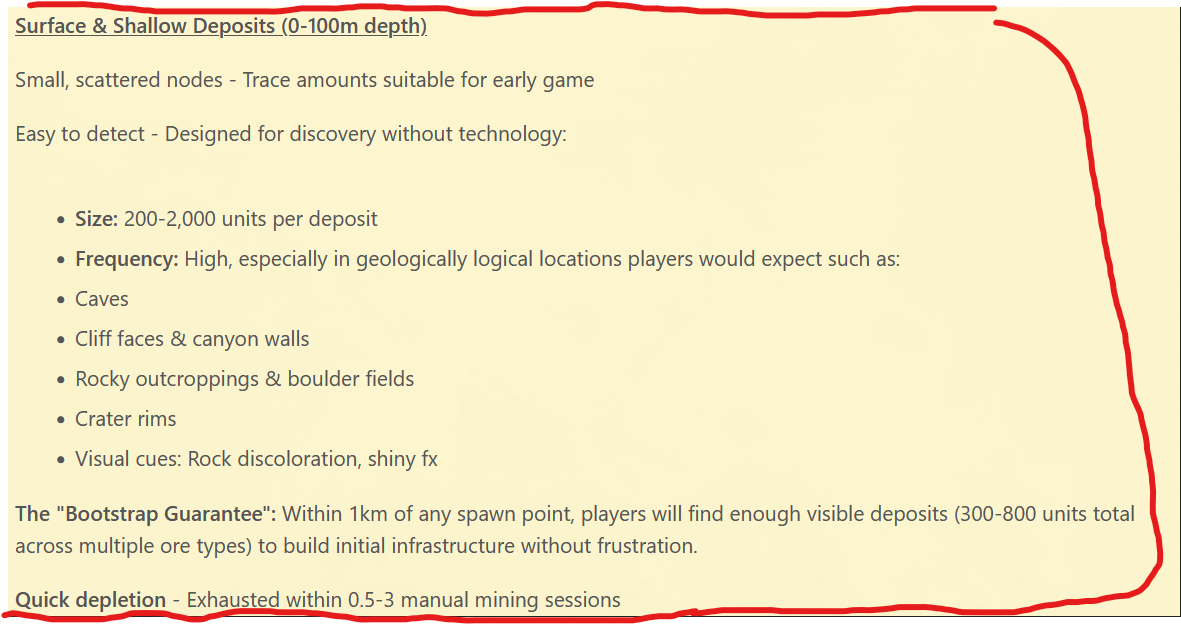
--------------------------------------------------------------------------------------------------
Part 1: The Ore Detector Problem
Before diving deeper into the ore system itself, there is a critical issue in SE2's current implementation that needs to be addressed: the player character should not have any ore-detecting capability.
Right now, when you pull out your drill in SE2, it essentially functions as a built-in ore detector, with GPS markers for nearby ores appearing directly on your HUD. This creates a jarring disconnect between the player and the game world. Instead of scanning the landscape, reading terrain features, or investing in detection infrastructure, the player simply follows a floating marker. For a game called Space Engineers, this is a deeply uninspiring interaction. It flattens what should be a moment of discovery into a mundane errand, and worse, it pulls your attention away from the genuinely stunning scenery SE2 has to offer.
------------------------------------------------------------------------------------------
------------------------------------------------------------------------------------------
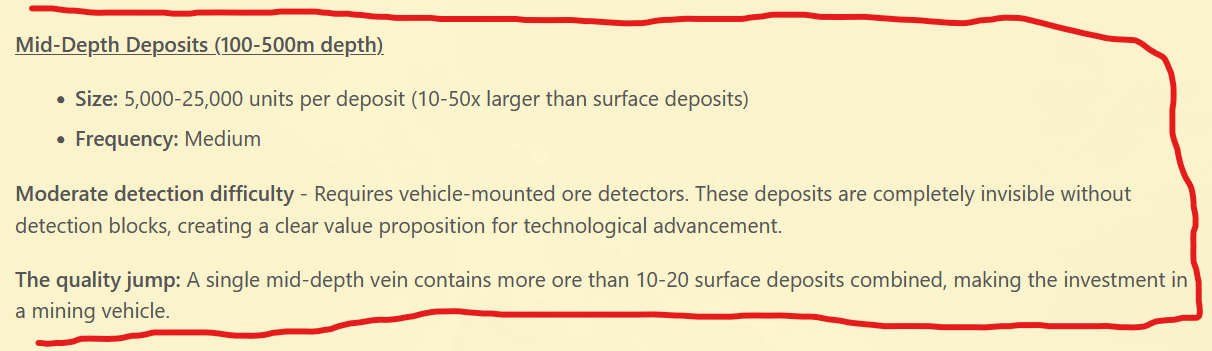
"These deposits are completely invisible without detection blocks"
When I said deposits should be invisible without detection blocks, what I meant is that they should be extremely difficult to locate without the right gear. Not literally invisible, but practically so without proper tools.
Rethinking the Ore Detector Block
The current ore detector block functions in a rudimentary way: it marks ores with GPS icons within a spherical radius around itself and nothing more. For a game with as much potential as SE2, this is a missed opportunity.
A far more engaging alternative would be a forward-facing scanner, a tractor-beam style detection block that actively sweeps terrain ahead of it:

Source1: here
When ore is detected, rather than producing a static GPS ping, it would illuminate and highlight the deposit within the world itself:

Source2: here
This distinction matters more than it might seem. Every small interaction in a game either adds to or subtracts from the overall feeling of engagement. A directional scanner that rewards the player for physically pointing it at the right terrain is inherently more satisfying and engaging than a passive GPS radius. It demands thought, it creates moments, and it makes the act of finding ore feel like an achievement rather than a chore. Features like this accumulate, and collectively they are what make a game genuinely fun to play.
Part 2: The Rush to Space and the Cost of Over-Simplification
It has been stated, by Keen Software House or by Marek Rosa himself, that the goal is to get players off the planet and into space/air quickly, to hook them with the spectacle of space content/flying a ship early. The intent is understandable, but the execution risks gutting the very thing that makes Space Engineers worth playing. You can find the source here and in the image:
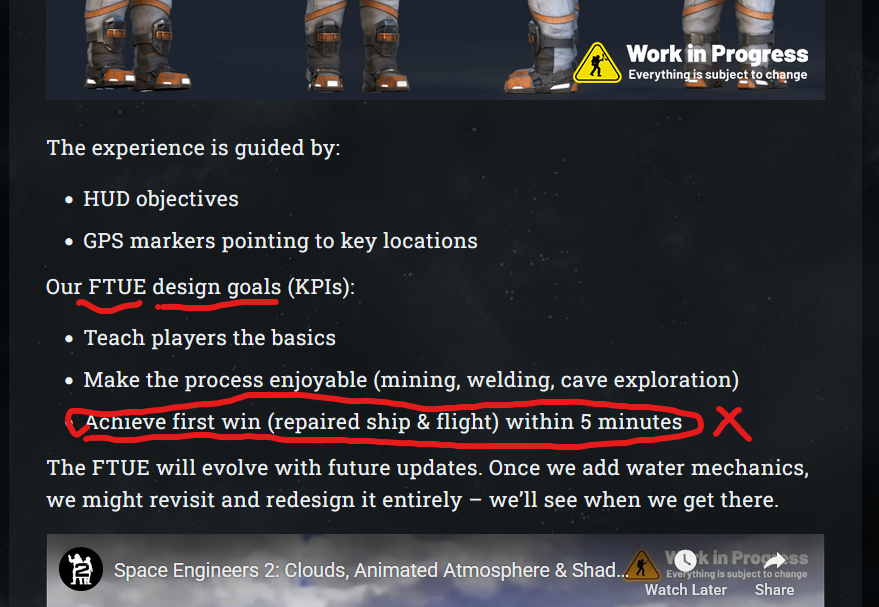
note: in this case, the ftue redesign comment at the bottom of the image is suggesting introducing players to water too. following the current trend, then perhaps it is by giving them a free water-faring ship as well. Not a great idea... players need to discover this stuff on their own rather than have to be spoon fed and forced. as well as having their joy of construction taken away,
The core gameplay loop of Space Engineers has always been survival, building, and mining. That loop does not live in space, air, or in a scenario where you get a ship for free and thoughtlessly. It lives on the ground, in the tension of having just barely enough materials to construct the next thing, in the decision of whether to dig deeper or venture further. Space is the destination, but the journey is the game, and right now SE2 is doing everything it can to skip the journey entirely.
In se1, the start of your gameplay is your drop pod landing down, then you grinding it down for resources or retrofitting it into something of your own creation. This is good. You get nothing else.
Meanwhile in se2, the player is handed a ship early on and funnelled toward a nearby space station to complete contracts. Those contracts, in their current form, are among the least compelling gameplay the series has ever produced. Making them individually interesting, dynamically generated, and meaningfully varied would require enormous development investment, and that effort would be fighting against the grain of what Space Engineers actually is. Marek Rosa himself has spoken about wanting low effort, big wins: small, easy-to-implement features that deliver outsized improvements to the experience. A rich, layered survival progression on the planet surface is precisely that kind of win. It does not require new systems from scratch. It requires taking what already exists, specifically mining, building, and survival, and making those systems deeper, more rewarding, and more purposeful than they were in SE1. The contracts system, by contrast, is a high-effort feature chasing a form of engagement that simply is not what this game's audience came for.
This tendency to rush players toward space is symptomatic of a broader issue in SE2's current design: the game is being simplified in ways that actively harm engagement. Nowhere is this clearer than in the production pipeline.
SE1 had a clear and satisfying production pathway involving specific blocks where ores were refined into ingots, and ingots were then crafted into components. SE2 removes the ingot stage entirely, going straight from ores to components and also adds backpack crafting for simple components. On its own, this is actually a reasonable call. It reduces friction and cognitive load for both newer and so-called "veteran" players, and the ingot stage in SE1 was not always meaningful. That change is defensible. Having backpack crafting is a great feature.
What is harder to defend is what Keen Software House has added on top of that simplification. There is currently an auto-conversion system that automatically turns ores in your inventory into components the moment you weld a block, with no input from the player required. Removing the ingot step reduced burden on the player, which was the right instinct, but auto-conversion goes further and removes the player's agency and thought entirely. The player is no longer making a decision; the game is making it for them. A new player would have no way of understanding what the heck is happening in that moment. This is the same fundamental problem as the drill acting as an ore detector. In both cases, the game is doing the thinking so the player does not have to, and the result is a session that feels less like playing a game and more like watching things happen.
The better solution is straightforward: remove auto-conversion, and instead let players copy a block's recipe, add it to their build planner, and queue the required components for crafting in their backpack. This keeps the streamlined one-stage production pipeline that SE2 has introduced while restoring the player's role as the one making deliberate choices. The reduction in steps is preserved and the sense of engagement is restored. Each individual simplification in SE2 might seem minor in isolation, but together they add up to a game that holds the player's hand at every turn, and that is the opposite of what Space Engineers should feel like.
Note 2: the current inventory crafting speed is way too fast and needs to be slowed down similar to the speeds in arc if this is implemented. which is a good thing btw.
Part 3: A Planned Progression
What follows is a proposed progression arc that uses the ore system as its backbone and gives the player a genuine sense of earning each stage of development.
Stage 1 - Grounded on Verdure
The player arrives on the surface of Verdure with nothing: no vehicle, no jetpack, or at most a jetpack with heavily limited fuel that is not suited for combat or extended use. They are ground-locked.
This is where the surface deposit system from my original post comes in. Small, visible ore traces in geologically logical locations like cliff faces, rocky outcroppings, and crater rims give the player just enough to start building: a small shelter, a basic refinery, the first real structure. The world around them is alive, with roaming creatures providing ambient danger and incentive to build defences, and cave systems offering both risk and resource.
This stage is unhurried. It is meant to feel like genuine survival and it is meant to be enjoyed, running around through nature and finding a location you like the look of.
Stage 2 - Settlement and Infrastructure
With surface resources beginning to thin, the player invests in their first mining vehicle. Ground rovers become the primary means of exploring and extracting mid-depth deposits between 100 and 500 metres down, which as outlined in my original proposal contain 10 to 50 times more ore than surface nodes and are undetectable without proper equipment.
This is also where a research and progression tree becomes essential. Currently, new blocks are unlocked through contracts, a system that as noted above delivers very little in terms of genuine engagement. A far better model exists in games like Ark: Survival Evolved, which uses a skill tree where players spend earned research points to unlock new crafting recipes and block types.

Source3: here
Research points could be earned through a range of natural gameplay activities: constructing blocks, mining ores, discovering new ores, crafting components, defeating creatures, finding new creatures, completing optional missions, exploration, finding landmarks or simply surviving over time. This ties progression organically to the act of playing, rather than routing it through a separate contract system that feels external to the rest of the game. Unlockable milestones might include suspension systems, ore detector blocks of the forward-facing scanner type described earlier, better drills, conveyor types, basic weaponry for surface and underground threats, and atmospheric thrusters unlocked toward the later portion of this stage.
Stage 2 is the heart of the game. It should be long, layered, and deeply satisfying.
Stage 3 - Breaking Atmosphere
The goal of Stage 3 is to achieve flight and eventually reach space. There are two meaningful routes to get there.
The unconventional route involves players who have unlocked low-tech weaponry using surface-available materials shooting down passing aircraft and salvaging thruster components from the wreckage. This would be an irrational approach for most players but a valid and interesting path for those who know exactly what they are doing, and perhaps particularly appealing for speedrunners.
The intended route sees the player, deep enough into Stage 2, having mined the mid-depth deposits and gained access to materials required for atmospheric or hydrogen thrusters. They build their first proper aircraft, break atmosphere, and make the transition from ground-locked engineer to aerial explorer. That transition is earned and felt in a way that simply is not possible when the game hands you a ship in the first ten minutes.
Stage 4 - The Space Saga Begins
With atmospheric flight achieved, the full scope of SE2's universe opens up. The colonisation system etc; everything else become accessible, and all of it carries weight because the player arrived here through genuine progression rather than a shortcut.
One thing worth reconsidering is the space station positioned directly outside Verdure's orbit. Its presence feels jarring and undermines the sense of discovery that should accompany reaching space for the first time. It raises questions the game does not answer and makes the universe feel smaller than it should. I do not have a definitive alternative to propose at this time, but it is worth the developers thinking carefully about. I believe it should not exist and rather you should get transported to kemik through a wormhole that pops up in a 'final verdure mission' of sorts but i digress.
Part 4: Additional Ideas
Underground creatures would add a great deal to the cave experience. Whether hostile fauna or something stranger, inhabitants in cave systems create inherent danger for deep mining operations and reward players who invest in combat-capable infrastructure or vehicles.
Explosive underground materials are another idea worth exploring. Scattered through cave systems and deep deposits, unstable materials could function as environmental hazards: weakly explosive on contact and capable of damaging unshielded vehicles or collapsing tunnels. If they visually resemble ore nodes, they introduce a small but meaningful element of risk into every mining operation and keep players attentive rather than complacent.
The goal of all of the above is the same as it was in my original post: to make resource management, and by extension the entire early-to-mid game, meaningful, layered, and engaging from start to finish. SE1 left a great deal on the table and SE2 has the opportunity to build something genuinely special. I hope this feedback contributes to that.
 I like this feedback
Oh yeah, I like this feedback. In particular, thank you for not mindlessly fixating on ingots. I agree; while backpack crafting is very convenient, auto-crafting is a problem that removes agency from players and insulates them from the process of production. It would be better to remove it and instead add a Production tab to the backpack, similar to the one in ships. Ironically, this change would make the whole system simpler and easier to understand.
Your proposed progression format is good and that's how I imagined it would work before Keen announced contracts. That being said, while I think existing contracts absolutely need to go (they're awful!), the contract system in general can be salvaged. A relatively small fix to the FTUE would be to make the tutorial give the player a rover, rather than a full spaceship and place a smaller contract station (without fast travel) on the surface of Verdure, instead of rushing players to space. Reaching Vallation Station would be a middle-term goal that the players would need to work towards.
Research in games is usually just a point-buy system. The important thing is to give points for activities the game is good at. Factorio is an automation game, so research points are mass-produced in a factory. Kerbal Space Program wants you follow real life space agencies, so you perform experiments in difficult-to-reach biomes in space. I feel what Space Engineers should promote is building structures and taking control over game environment. Combat is also good, as it naturally encourages to build the economy to support warships.
Oh yeah, I like this feedback. In particular, thank you for not mindlessly fixating on ingots. I agree; while backpack crafting is very convenient, auto-crafting is a problem that removes agency from players and insulates them from the process of production. It would be better to remove it and instead add a Production tab to the backpack, similar to the one in ships. Ironically, this change would make the whole system simpler and easier to understand.
Your proposed progression format is good and that's how I imagined it would work before Keen announced contracts. That being said, while I think existing contracts absolutely need to go (they're awful!), the contract system in general can be salvaged. A relatively small fix to the FTUE would be to make the tutorial give the player a rover, rather than a full spaceship and place a smaller contract station (without fast travel) on the surface of Verdure, instead of rushing players to space. Reaching Vallation Station would be a middle-term goal that the players would need to work towards.
Research in games is usually just a point-buy system. The important thing is to give points for activities the game is good at. Factorio is an automation game, so research points are mass-produced in a factory. Kerbal Space Program wants you follow real life space agencies, so you perform experiments in difficult-to-reach biomes in space. I feel what Space Engineers should promote is building structures and taking control over game environment. Combat is also good, as it naturally encourages to build the economy to support warships.
Bump. To make the topic more visible
Bump. To make the topic more visible
Nice post, you summarize some of the challenges currently faced.
You wrote a long post, so I thought I would, too.
Intro: I will try to limit the philosophy introduced, to a few key concepts. The ideas must Cohere together within the world, Correspond to the systems set up in the world, and have a logical Reason and meaning for the player to choose from when deciding how to proceed in the world. For Example, using a Spectrometry system to find ore. Why? A computer interpreta the squiggly lines anyways, and tells you what they are. The meaning behind it is, it is really a -long- range scanner, and being able to read the squiggly lines gives meaning, in how scientist in real life run analysis on readings, so it ties you to their 'real life' meaning into your gameplay. Does it cohere to the Gameworld? No, it does not. No other system is like it, when using different systems or equipment.
Part One
A directional short range scanner is a good idea, but probably it should instead be used for as a basis for -long- range scanning. Why? A short range directional scanner on a ...how many kilometer world...? Or worlds...? How about saying a directional scanner has a longer range, since it is focused? That the diameter of the scanning aperture is dynamically controllable by the player, from a short-range 'sphere', to a mid-range 'cone', to a long-range 'laser', that will scale exponentially in range...?
It would fit with existing systems, the range could even scale to how soon asteroids render into the game world, and the player can adjust range and diameter as the situation is required. Simple to code, easy to use, and in line with how the existing detection system logic operates. In practice, a scenario would look like: you see an asteroid off in the distance (or while flying a mountain, or looking down in orbit around a planet), and decide to scan. You dial up the range, and your detection sphere dynamically morphs into a forward facing cone, and as you continually increase the range (or narrow the scanner radius) it morphs into a laser that can just reach the asteroid. Now...you 'paint' the target, seeing if you get any hits, using a camera if it can help. As you work the laser around the surface, you get 'hits' of iron, silicon, as the laser passes over them, on your hud as we are now. You see a quick blurb if uranium. You move the laser around some more, but can't hit it again. So, you decide to move closer, and investigate. It is probably a small deposit, but you don't know if it is facing you, on the inside, or the far-side. As you get closer, you slowly widen the aperture untill you are in range, and can make a large enough of a scan circle that covers the whole asteroid, and you can actually see all the deposits. As you move in to start mining, you widen it back out to a sphere, so you get see everything while inside the asteroid.
Part 2
Suit only start. I would suggest that gameplay be based off that start, logically. Different starting scenarios are already there, and even more will be setup, but at a first principles, it should be based on that. It would mean a couple changes. If the build rate is slowed down for non-ore-based manufacturing, it would balance a lot of things out. As for loading schematics, a 'Build Planner' already fulfills that function, when it will be added to the game, so kinda redundant. I posted elsewhere on this, so there is a little deeper suit-only-start discussion there, as well, if you want it.
Part 3
Separate the faction contract progression from block progression. The idea of research points is a way, were you accumulate points. I would caution from the idea of arbitrary numbers, and look for something that is already 'in' the game that we collect...like ore. Have every single ore type stacked on the left side of the screen, as discovered, on top of one another. Then, have every single block, that runs out to the right, in a giant research tree. You unlock different blocks as you gather the available ore in your unique biome, put the required amount into the storage for the research block(building out the 'research' infrastructure, as times and amounts increase the further you progress), and let it research the required time (with upgrade slots) to progress along the tree. In hypothetical example, the Iron tree starts with light armor block. As you gather the amount of iron needed, put into the Research 'input' inventory, click research. Takes a minute. That unlocks the next light armor variant. (amounts and times are adjustable in the menu for a quicker or more difficult playthrough). As you quickly progress along the 'iron' tree, you hit a block that requires iron...and nickel. So...now you have to go explore. And you are getting low on iron.
That is the concept. You nailed the point on where progress is tied to transportation. There are natural 'gates', that appear when specific ores are tied to specific biomes, which means...a progression system already exist! It just should be formally incorporated into gameplay. This idea means that different starts in different biomes will naturally encourage unique block progressions on your playthrough. An example, a water world would mean access to the silicon, iron trees I.e., which would be primarily access to water based blocks, water transportation technology, and base building. A space start would mean the 'space' tree, untill you can get to other ores and unlock other blocks. I also posted on this in other places.
Part 4
Yes! A reason now that players don't really fully 'explore' deep underground, is that they go in blind. The ore laser would scan deep, giving the reason to explore down, and for a reason that Keen can develop more of the 'deep earth' stuff and ideas.(-I later added this in Edit- Also, the 'Heros Journey', where you return home after a long journey. After traveling to the far reaches of the system to find the rare ores, and have unlocked end-game blocks, you return to Verdure, and surprisingly, deep underground there are some really good end-game resources, that you can now acces. Just saying:)
Finally...Factions. There is a history here, will be interesting to see the remains of past factions, their outpost and bases. Of wars. Trying to investigate an learn as you explore the past history of Algamest System. Logically, one piece of technology that would provide the reason for the people to fight, for a developed world already ahead of us, something worth trying to control at any price...a warp gate. Earth...or to other systems.
Nice post, you summarize some of the challenges currently faced.
You wrote a long post, so I thought I would, too.
Intro: I will try to limit the philosophy introduced, to a few key concepts. The ideas must Cohere together within the world, Correspond to the systems set up in the world, and have a logical Reason and meaning for the player to choose from when deciding how to proceed in the world. For Example, using a Spectrometry system to find ore. Why? A computer interpreta the squiggly lines anyways, and tells you what they are. The meaning behind it is, it is really a -long- range scanner, and being able to read the squiggly lines gives meaning, in how scientist in real life run analysis on readings, so it ties you to their 'real life' meaning into your gameplay. Does it cohere to the Gameworld? No, it does not. No other system is like it, when using different systems or equipment.
Part One
A directional short range scanner is a good idea, but probably it should instead be used for as a basis for -long- range scanning. Why? A short range directional scanner on a ...how many kilometer world...? Or worlds...? How about saying a directional scanner has a longer range, since it is focused? That the diameter of the scanning aperture is dynamically controllable by the player, from a short-range 'sphere', to a mid-range 'cone', to a long-range 'laser', that will scale exponentially in range...?
It would fit with existing systems, the range could even scale to how soon asteroids render into the game world, and the player can adjust range and diameter as the situation is required. Simple to code, easy to use, and in line with how the existing detection system logic operates. In practice, a scenario would look like: you see an asteroid off in the distance (or while flying a mountain, or looking down in orbit around a planet), and decide to scan. You dial up the range, and your detection sphere dynamically morphs into a forward facing cone, and as you continually increase the range (or narrow the scanner radius) it morphs into a laser that can just reach the asteroid. Now...you 'paint' the target, seeing if you get any hits, using a camera if it can help. As you work the laser around the surface, you get 'hits' of iron, silicon, as the laser passes over them, on your hud as we are now. You see a quick blurb if uranium. You move the laser around some more, but can't hit it again. So, you decide to move closer, and investigate. It is probably a small deposit, but you don't know if it is facing you, on the inside, or the far-side. As you get closer, you slowly widen the aperture untill you are in range, and can make a large enough of a scan circle that covers the whole asteroid, and you can actually see all the deposits. As you move in to start mining, you widen it back out to a sphere, so you get see everything while inside the asteroid.
Part 2
Suit only start. I would suggest that gameplay be based off that start, logically. Different starting scenarios are already there, and even more will be setup, but at a first principles, it should be based on that. It would mean a couple changes. If the build rate is slowed down for non-ore-based manufacturing, it would balance a lot of things out. As for loading schematics, a 'Build Planner' already fulfills that function, when it will be added to the game, so kinda redundant. I posted elsewhere on this, so there is a little deeper suit-only-start discussion there, as well, if you want it.
Part 3
Separate the faction contract progression from block progression. The idea of research points is a way, were you accumulate points. I would caution from the idea of arbitrary numbers, and look for something that is already 'in' the game that we collect...like ore. Have every single ore type stacked on the left side of the screen, as discovered, on top of one another. Then, have every single block, that runs out to the right, in a giant research tree. You unlock different blocks as you gather the available ore in your unique biome, put the required amount into the storage for the research block(building out the 'research' infrastructure, as times and amounts increase the further you progress), and let it research the required time (with upgrade slots) to progress along the tree. In hypothetical example, the Iron tree starts with light armor block. As you gather the amount of iron needed, put into the Research 'input' inventory, click research. Takes a minute. That unlocks the next light armor variant. (amounts and times are adjustable in the menu for a quicker or more difficult playthrough). As you quickly progress along the 'iron' tree, you hit a block that requires iron...and nickel. So...now you have to go explore. And you are getting low on iron.
That is the concept. You nailed the point on where progress is tied to transportation. There are natural 'gates', that appear when specific ores are tied to specific biomes, which means...a progression system already exist! It just should be formally incorporated into gameplay. This idea means that different starts in different biomes will naturally encourage unique block progressions on your playthrough. An example, a water world would mean access to the silicon, iron trees I.e., which would be primarily access to water based blocks, water transportation technology, and base building. A space start would mean the 'space' tree, untill you can get to other ores and unlock other blocks. I also posted on this in other places.
Part 4
Yes! A reason now that players don't really fully 'explore' deep underground, is that they go in blind. The ore laser would scan deep, giving the reason to explore down, and for a reason that Keen can develop more of the 'deep earth' stuff and ideas.(-I later added this in Edit- Also, the 'Heros Journey', where you return home after a long journey. After traveling to the far reaches of the system to find the rare ores, and have unlocked end-game blocks, you return to Verdure, and surprisingly, deep underground there are some really good end-game resources, that you can now acces. Just saying:)
Finally...Factions. There is a history here, will be interesting to see the remains of past factions, their outpost and bases. Of wars. Trying to investigate an learn as you explore the past history of Algamest System. Logically, one piece of technology that would provide the reason for the people to fight, for a developed world already ahead of us, something worth trying to control at any price...a warp gate. Earth...or to other systems.
The key takeaway from all this can be reduced to this:
The game progression has to be slow and meaningful.
Currently, there is barely any survival in the game. You start with a lot of staff around you and a full-fledged factory on your back with resources scattered all around you. You take many things for granted and don't value anything as a consequence. Adding more survival features like food and hazards can help a bit, but the deep survival gameplay must emerge from simple features and thoroughly tied into meaningful progression.
Now I'd like to add a couple of comments about specific things that have been mentioned in this topic.
First and foremost, I'd like to talk about "researching" or "tech trees" or whatever you call it. I believe a progression system similar to what we had in SE1 was a mistake. It feels arbitrary and often adds just 1 unnecessary step in your way instead of being anything engaging or really meaningful. Building a landing gear and then instantly grinding it down only because you need to build some other block is just bad IMO.
I think you should be able to build anything once you have the necessary resources or items to do so. Basic resources should be relatively easy to find anywhere, in small quantities, allowing you to progress in the early game. After that, you need to get your hands on additional resources and more abundant deposits in order to progress further. Fortunately, we now have even more resources in the game, allowing for much more gradual (or branched/alternative) progression. In addition to resources, there might be certain uncraftable items or entire blocks you need to somehow obtain in order to progress into specific end game capabilities. How do you obtain those might differ. For some, you might need to befriend a specific NPC faction and then buy or earn it by doing missions; others can be found in different random encounters. The difficulty of obtaining those end-game resources and items should scale proportionally to the "power" of things you are allowed to do with them. For example, in order to build a jump drive, you might need to buy a specific blueprint from an NPC faction you have really good terms with, or find it as a loot after clearing a difficult encounter. In addition to "standard" end game content, there also can be specific items/blueprints/consumables allowing you to make specific things. Think about weapons. Say there are 3 main types of weapons: energy, missiles and close-range point defense. There might be 3 factions in the game each having a slightly better version of one type. You will still be able to build all 3 types, but if you have a hi rep with a specific faction, you have access to that better version giving you a small edge. You can also strategize in combat against certain factions and players knowing about their advantages. And you might try to get a somewhat good rep with two factions, but it would be almost impossible to have good terms with all 3 (raising a rep with one could lower it with another). Besides weapons, there might be some unique production modules allowing you to excel in a particular production chain (having the best energy/PCU to output ratio). This would naturally promote specialization and trade. Some unique production modules or blueprints can also be found if you explore a lot, giving you an alternative way to obtain those end-game capabilities.
To summarize, no need for arbitrary progression "locks", access to specific resources and items allows you to progress naturally. Start with basics. Prospect for additional resources. Finding those should not be easy. Build a resilient exploration vehicle/ship, go to different biomes with harsh weather or other hazards. Leave the planet in search for additional resources. Explore or befriend NPC factions to obtain specific technologies, come back to the planet now able to find huge deposits deep underground, specialize and trade.
And yeah, you might be lucky to find some small amount of valuable resources or rare items too early, and that's fine. That's a viable strategy. If you pair this with some knowledge-based gameplay strategy, it can open up a whole world for speed runners and alternative playstyles.
The key takeaway from all this can be reduced to this:
The game progression has to be slow and meaningful.
Currently, there is barely any survival in the game. You start with a lot of staff around you and a full-fledged factory on your back with resources scattered all around you. You take many things for granted and don't value anything as a consequence. Adding more survival features like food and hazards can help a bit, but the deep survival gameplay must emerge from simple features and thoroughly tied into meaningful progression.
Now I'd like to add a couple of comments about specific things that have been mentioned in this topic.
First and foremost, I'd like to talk about "researching" or "tech trees" or whatever you call it. I believe a progression system similar to what we had in SE1 was a mistake. It feels arbitrary and often adds just 1 unnecessary step in your way instead of being anything engaging or really meaningful. Building a landing gear and then instantly grinding it down only because you need to build some other block is just bad IMO.
I think you should be able to build anything once you have the necessary resources or items to do so. Basic resources should be relatively easy to find anywhere, in small quantities, allowing you to progress in the early game. After that, you need to get your hands on additional resources and more abundant deposits in order to progress further. Fortunately, we now have even more resources in the game, allowing for much more gradual (or branched/alternative) progression. In addition to resources, there might be certain uncraftable items or entire blocks you need to somehow obtain in order to progress into specific end game capabilities. How do you obtain those might differ. For some, you might need to befriend a specific NPC faction and then buy or earn it by doing missions; others can be found in different random encounters. The difficulty of obtaining those end-game resources and items should scale proportionally to the "power" of things you are allowed to do with them. For example, in order to build a jump drive, you might need to buy a specific blueprint from an NPC faction you have really good terms with, or find it as a loot after clearing a difficult encounter. In addition to "standard" end game content, there also can be specific items/blueprints/consumables allowing you to make specific things. Think about weapons. Say there are 3 main types of weapons: energy, missiles and close-range point defense. There might be 3 factions in the game each having a slightly better version of one type. You will still be able to build all 3 types, but if you have a hi rep with a specific faction, you have access to that better version giving you a small edge. You can also strategize in combat against certain factions and players knowing about their advantages. And you might try to get a somewhat good rep with two factions, but it would be almost impossible to have good terms with all 3 (raising a rep with one could lower it with another). Besides weapons, there might be some unique production modules allowing you to excel in a particular production chain (having the best energy/PCU to output ratio). This would naturally promote specialization and trade. Some unique production modules or blueprints can also be found if you explore a lot, giving you an alternative way to obtain those end-game capabilities.
To summarize, no need for arbitrary progression "locks", access to specific resources and items allows you to progress naturally. Start with basics. Prospect for additional resources. Finding those should not be easy. Build a resilient exploration vehicle/ship, go to different biomes with harsh weather or other hazards. Leave the planet in search for additional resources. Explore or befriend NPC factions to obtain specific technologies, come back to the planet now able to find huge deposits deep underground, specialize and trade.
And yeah, you might be lucky to find some small amount of valuable resources or rare items too early, and that's fine. That's a viable strategy. If you pair this with some knowledge-based gameplay strategy, it can open up a whole world for speed runners and alternative playstyles.
Here are two scenarios for the default progression, see which is more appealing to players:
Scenario one:
"I just unlocked lvl 3, so now I am farming points to get to railguns."
Scenerio two:
"I just added storage, and got it all piped up, for my research block(s), along with the modules I want. The iron, nickel, platinum trees gave me large hydrogen thrusters. Now, for railguns I need tritium, which I found scouting, at Byblos. It is underwater, so right now I am preparing for an expedition to go there and start on the silicon-sulfer research trees for the underwater specific blocks."
One works more in a specific faction's ranks/blocks/progression way, the other as the general 'overall' game tech progression, for player.
Just include both. Points for faction advancement, research unlocks for block and infrastructure.
You could also design things that 'dip' into either one, i.e. faction blocks, as people mentioned about.
Here are two scenarios for the default progression, see which is more appealing to players:
Scenario one:
"I just unlocked lvl 3, so now I am farming points to get to railguns."
Scenerio two:
"I just added storage, and got it all piped up, for my research block(s), along with the modules I want. The iron, nickel, platinum trees gave me large hydrogen thrusters. Now, for railguns I need tritium, which I found scouting, at Byblos. It is underwater, so right now I am preparing for an expedition to go there and start on the silicon-sulfer research trees for the underwater specific blocks."
One works more in a specific faction's ranks/blocks/progression way, the other as the general 'overall' game tech progression, for player.
Just include both. Points for faction advancement, research unlocks for block and infrastructure.
You could also design things that 'dip' into either one, i.e. faction blocks, as people mentioned about.
Good post. I am disappointed about the design of SE2 as well. "Engineering? No thanks, here's a checklist".
IMO progression should be about expansion (actual colonization), networking, research and engineering (not repairing).
Good post. I am disappointed about the design of SE2 as well. "Engineering? No thanks, here's a checklist".
IMO progression should be about expansion (actual colonization), networking, research and engineering (not repairing).
The necessity to point the sensor in the right direction is such a non-challenge that it's virtually indistinguishable from the current ore detector. A better idea would be to have a long-range sensor that alerts you about the presence of ore (even deep underground), but doesn't tell you where it is. It would just be a start to a serious effort towards finding it.
The necessity to point the sensor in the right direction is such a non-challenge that it's virtually indistinguishable from the current ore detector. A better idea would be to have a long-range sensor that alerts you about the presence of ore (even deep underground), but doesn't tell you where it is. It would just be a start to a serious effort towards finding it.
Oh yeah, I like this feedback. In particular, thank you for not mindlessly fixating on ingots. I agree; while backpack crafting is very convenient, auto-crafting is a problem that removes agency from players and insulates them from the process of production. It would be better to remove it and instead add a Production tab to the backpack, similar to the one in ships. Ironically, this change would make the whole system simpler and easier to understand.
Your proposed progression format is good and that's how I imagined it would work before Keen announced contracts. That being said, while I think existing contracts absolutely need to go (they're awful!), the contract system in general can be salvaged. A relatively small fix to the FTUE would be to make the tutorial give the player a rover, rather than a full spaceship and place a smaller contract station (without fast travel) on the surface of Verdure, instead of rushing players to space. Reaching Vallation Station would be a middle-term goal that the players would need to work towards.
Research in games is usually just a point-buy system. The important thing is to give points for activities the game is good at. Factorio is an automation game, so research points are mass-produced in a factory. Kerbal Space Program wants you follow real life space agencies, so you perform experiments in difficult-to-reach biomes in space. I feel what Space Engineers should promote is building structures and taking control over game environment. Combat is also good, as it naturally encourages to build the economy to support warships.
Oh yeah, I like this feedback. In particular, thank you for not mindlessly fixating on ingots. I agree; while backpack crafting is very convenient, auto-crafting is a problem that removes agency from players and insulates them from the process of production. It would be better to remove it and instead add a Production tab to the backpack, similar to the one in ships. Ironically, this change would make the whole system simpler and easier to understand.
Your proposed progression format is good and that's how I imagined it would work before Keen announced contracts. That being said, while I think existing contracts absolutely need to go (they're awful!), the contract system in general can be salvaged. A relatively small fix to the FTUE would be to make the tutorial give the player a rover, rather than a full spaceship and place a smaller contract station (without fast travel) on the surface of Verdure, instead of rushing players to space. Reaching Vallation Station would be a middle-term goal that the players would need to work towards.
Research in games is usually just a point-buy system. The important thing is to give points for activities the game is good at. Factorio is an automation game, so research points are mass-produced in a factory. Kerbal Space Program wants you follow real life space agencies, so you perform experiments in difficult-to-reach biomes in space. I feel what Space Engineers should promote is building structures and taking control over game environment. Combat is also good, as it naturally encourages to build the economy to support warships.
Once NPC factions are introduced, additional options for progressing tech wise could be
1) making friends and gaining tech from them by trade or joint projects
2) looting tech from hostile factions and reverse engineering it in a lab
But I'm getting a little off topic. Regarding the OP's suggestions, I think the proposed deposits are too small by a factor of maybe ten. One deposit should be enough to build a minimal base and one vehicle for scouting/mining. For a friendly environment like Verdure, I'm thinking of a few grated catwalks, a med kit, some modest renewable energy source and a battery. For the vehicle, something similar to the Grasshopper (I have my reservations about the design, but the size is about right.) Or a similarly sized rover.
Once NPC factions are introduced, additional options for progressing tech wise could be
1) making friends and gaining tech from them by trade or joint projects
2) looting tech from hostile factions and reverse engineering it in a lab
But I'm getting a little off topic. Regarding the OP's suggestions, I think the proposed deposits are too small by a factor of maybe ten. One deposit should be enough to build a minimal base and one vehicle for scouting/mining. For a friendly environment like Verdure, I'm thinking of a few grated catwalks, a med kit, some modest renewable energy source and a battery. For the vehicle, something similar to the Grasshopper (I have my reservations about the design, but the size is about right.) Or a similarly sized rover.
I think it would be helpful to the discussion to actually try and identify what 'research' actually is.
Is it a college laboratory, which is .. 'nebulous' for SE2, or something better?
A 3D-printing cycle would be an excellent analogy, as a connection to making a block in-game emerged.
So, a fresh start has:
1. Locate a ore deposit, extract some stock.
2. Test stock to see properties (acts like iron)
3. Add stock to 3D-Printer to make a prototype armor block.
4. Test block, make adjustments, repeat Step 3 and Step 4, iterating until....
5. Use the final model for mass production.
So, if we replace the 3D-printer with a research block, and find an average time for the combined steps of 2-4, we get a pretty standard production loop that fits with existing gameplay.
For time and stock material requirements, work backwards from the finished block. Final block takes 5 sec and 1 unit of ore to make? Then say the prototyping and iterating took 50x longer time, and 10x the ore, for the final product (just as example).
What you have there, is a baseline to adjust off of.
Then, in the SE2 main menu, have players able to adjust those two ratios, for different gameplay desires. Shorter time or less ore, longer time or more ore.
The arbitrary nature is still there, but now the decision is up to you how you want it to feel, meaning how arbitrary those should be is now up to you.
And, there are now 5 main play styles for the player:
1. Easy - both setting to min
2. Normal - both setting to middle, as determined by Keen for a 'general' difficulty and time required to do a new game-run.
3. Normal Wide - Time set to max, Resource amount to min. This incentivises a gameplay style to get as many different research trees going as possible, with as many different ores available.
4. Normal Deep - This incentivises a gameplay style to aquire as much of one ore type as possible, to maximize the amount of blocks unlocked that use that ore.
5. Insane - sliders maximum
I think it would be helpful to the discussion to actually try and identify what 'research' actually is.
Is it a college laboratory, which is .. 'nebulous' for SE2, or something better?
A 3D-printing cycle would be an excellent analogy, as a connection to making a block in-game emerged.
So, a fresh start has:
1. Locate a ore deposit, extract some stock.
2. Test stock to see properties (acts like iron)
3. Add stock to 3D-Printer to make a prototype armor block.
4. Test block, make adjustments, repeat Step 3 and Step 4, iterating until....
5. Use the final model for mass production.
So, if we replace the 3D-printer with a research block, and find an average time for the combined steps of 2-4, we get a pretty standard production loop that fits with existing gameplay.
For time and stock material requirements, work backwards from the finished block. Final block takes 5 sec and 1 unit of ore to make? Then say the prototyping and iterating took 50x longer time, and 10x the ore, for the final product (just as example).
What you have there, is a baseline to adjust off of.
Then, in the SE2 main menu, have players able to adjust those two ratios, for different gameplay desires. Shorter time or less ore, longer time or more ore.
The arbitrary nature is still there, but now the decision is up to you how you want it to feel, meaning how arbitrary those should be is now up to you.
And, there are now 5 main play styles for the player:
1. Easy - both setting to min
2. Normal - both setting to middle, as determined by Keen for a 'general' difficulty and time required to do a new game-run.
3. Normal Wide - Time set to max, Resource amount to min. This incentivises a gameplay style to get as many different research trees going as possible, with as many different ores available.
4. Normal Deep - This incentivises a gameplay style to aquire as much of one ore type as possible, to maximize the amount of blocks unlocked that use that ore.
5. Insane - sliders maximum
There are a variety of suggestion issues around the gameplay topic. If you agree with this well thought out version, you should also go and give some love to the less well stated ones where the same issue is being brought up.
I think Keen is "betting the farm" on this new game engagement strategy and is getting a lot of positive feedback about these same topics from players who IN MY OPINION, either did not play the SE1 Survival gameplay loop without mods to remove that gameplay from the loop, or they never played they game because it required too much of a mental/time investment to figure it out.
Because of all the positive feedback... I think they kind of ignore this kind of feedback.
There are a variety of suggestion issues around the gameplay topic. If you agree with this well thought out version, you should also go and give some love to the less well stated ones where the same issue is being brought up.
I think Keen is "betting the farm" on this new game engagement strategy and is getting a lot of positive feedback about these same topics from players who IN MY OPINION, either did not play the SE1 Survival gameplay loop without mods to remove that gameplay from the loop, or they never played they game because it required too much of a mental/time investment to figure it out.
Because of all the positive feedback... I think they kind of ignore this kind of feedback.
Thanks for the extremely detailed write-up I’ve read through this carefully.
There’s a lot of strong thinking here around progression pacing, discovery, and how core systems like mining, scanning, crafting, and travel all feed into the “earn your way forward” loop that many players value in Space Engineers.
We’re already actively working through a number of the areas you touch on, especially:
Some of your specific proposals go much further in restructuring core systems, but the underlying themes reducing automation of decision-making, improving discovery, and making progression feel earned are very aligned with discussions happening internally.
This has been passed to the team for review as part of ongoing progression and survival loop evaluation.
Appreciate the time and effort you put into this feedback like this is useful for understanding not just what players want changed, but why the current experience feels the way it does.
Arron, Community Manager
Thanks for the extremely detailed write-up I’ve read through this carefully.
There’s a lot of strong thinking here around progression pacing, discovery, and how core systems like mining, scanning, crafting, and travel all feed into the “earn your way forward” loop that many players value in Space Engineers.
We’re already actively working through a number of the areas you touch on, especially:
Some of your specific proposals go much further in restructuring core systems, but the underlying themes reducing automation of decision-making, improving discovery, and making progression feel earned are very aligned with discussions happening internally.
This has been passed to the team for review as part of ongoing progression and survival loop evaluation.
Appreciate the time and effort you put into this feedback like this is useful for understanding not just what players want changed, but why the current experience feels the way it does.
Arron, Community Manager
A late thought about how to do ore deposits:
People keep complaining about having to dig lots of little holes, making the landscape look like a rabbit warren.
Right now, we have boulders lying on the surface you can crack with the drill, but they give no resources. I suggest making these give a modest amount of ore each, maybe 20-50 units, and reduce the amount gained from dirt mining so that becomes an absolute last resort. Dirt mining should be more like in SE1, slow and a PITA you want to leave behind ASAP.
For the larger, subterranean nodes I suggest semi-random locations and sliders for shallow <-> deep and small <-> large. Personally I like playing with the Deeper Ores mod in SE1, which gives bigger ore deposits but also requires you to dig deeper. But I understand that might not be to everyone's taste.
A late thought about how to do ore deposits:
People keep complaining about having to dig lots of little holes, making the landscape look like a rabbit warren.
Right now, we have boulders lying on the surface you can crack with the drill, but they give no resources. I suggest making these give a modest amount of ore each, maybe 20-50 units, and reduce the amount gained from dirt mining so that becomes an absolute last resort. Dirt mining should be more like in SE1, slow and a PITA you want to leave behind ASAP.
For the larger, subterranean nodes I suggest semi-random locations and sliders for shallow <-> deep and small <-> large. Personally I like playing with the Deeper Ores mod in SE1, which gives bigger ore deposits but also requires you to dig deeper. But I understand that might not be to everyone's taste.
Absolutely. Loved every bit of info and suggestions in the post.
Absolutely. Loved every bit of info and suggestions in the post.
Oh yes I love everything about the progression part of this suggestion! It sounds so much fun!
The ore distribution ideas seem fine as well as long as there's a means to detect the deeper ones, and I'd really like if something like the SE1 ore spectroscopy mod's features could be used here, it could fit greatly in this aspect?
But for me the real gem of this suggestion is the progression mechanics, the way you'd unlock blocks with XP gained from doing all the mining, using machines, building, exploring and fighting! I'd suggest that these activities' XP could also be boosted by doing them in a new location, i.e. mining and building blocks on a new planet could award x2-x3 the amount of XP for some fixed amount until declining towards the regular amount, thus further encouraging travelling to new locations and setting up outposts on the moons for example.
You could still have contracts that award certain blocks for free, and maybe also "scanning" an enemy block with the welder could also provide another way to unlock a block without spending XP.
I'm not particularly interested in using ores or materials to research blocks, as was suggested in another comment. Resources feel too precious and scarce for that especially at the beginning and even later when doing bigger projects, I'd hate the feeling of having to "throw away" materials that I could use for building?
Oh yes I love everything about the progression part of this suggestion! It sounds so much fun!
The ore distribution ideas seem fine as well as long as there's a means to detect the deeper ones, and I'd really like if something like the SE1 ore spectroscopy mod's features could be used here, it could fit greatly in this aspect?
But for me the real gem of this suggestion is the progression mechanics, the way you'd unlock blocks with XP gained from doing all the mining, using machines, building, exploring and fighting! I'd suggest that these activities' XP could also be boosted by doing them in a new location, i.e. mining and building blocks on a new planet could award x2-x3 the amount of XP for some fixed amount until declining towards the regular amount, thus further encouraging travelling to new locations and setting up outposts on the moons for example.
You could still have contracts that award certain blocks for free, and maybe also "scanning" an enemy block with the welder could also provide another way to unlock a block without spending XP.
I'm not particularly interested in using ores or materials to research blocks, as was suggested in another comment. Resources feel too precious and scarce for that especially at the beginning and even later when doing bigger projects, I'd hate the feeling of having to "throw away" materials that I could use for building?
On the whole, I think you're asking for too much in one go. It's too complicated as a system.
The larger ore deposits would make for more interesting gameplay, at least as long as tech progression allows us to build machines without having to leave Verdure to get gold to build an assembler. I don't remember the in-game numbers, but I don't feel your proposed mid-size deposits are large enough yet to really beg for proper engineering. They might justify a tiny flying miner, but I want ore deposits worth setting up satellite bases for. Conveyors to move the ore to the surface as I mine; containers and docking ports for cargo craft to connect to; maybe even local refineries if Keen rethinks the outrageous 1:1 ore-conversion.
Even the mines that turn up in scenarios in SE2 are in total far larger than what you propose for "medium"
I hate the tiny ore deposits. It takes longer to get to the little buggers than to mine them out, and now this beautiful terrain I'm supposed to be admiring is pockmarked with gopher holes everywhere. It also removes all incentive to explore further than a few hundred meters, never mind build. And that basically sabotages any better gameplay.
I liked the deposit sizes in SE1, and would even say that some should be much larger. But ore to ingot (or end product) conversion should be far less efficient than either game. Real gold mines move and process whole mountains for tiny quantities of pure gold. That gives you more incentive to build cool machines to mine and move vast quantities of ore without letting you end up with more materials than you know what to do with.
On the whole, I think you're asking for too much in one go. It's too complicated as a system.
The larger ore deposits would make for more interesting gameplay, at least as long as tech progression allows us to build machines without having to leave Verdure to get gold to build an assembler. I don't remember the in-game numbers, but I don't feel your proposed mid-size deposits are large enough yet to really beg for proper engineering. They might justify a tiny flying miner, but I want ore deposits worth setting up satellite bases for. Conveyors to move the ore to the surface as I mine; containers and docking ports for cargo craft to connect to; maybe even local refineries if Keen rethinks the outrageous 1:1 ore-conversion.
Even the mines that turn up in scenarios in SE2 are in total far larger than what you propose for "medium"
I hate the tiny ore deposits. It takes longer to get to the little buggers than to mine them out, and now this beautiful terrain I'm supposed to be admiring is pockmarked with gopher holes everywhere. It also removes all incentive to explore further than a few hundred meters, never mind build. And that basically sabotages any better gameplay.
I liked the deposit sizes in SE1, and would even say that some should be much larger. But ore to ingot (or end product) conversion should be far less efficient than either game. Real gold mines move and process whole mountains for tiny quantities of pure gold. That gives you more incentive to build cool machines to mine and move vast quantities of ore without letting you end up with more materials than you know what to do with.
I didn't read everything but what I did all sounded good. Main thing I really wanted to mention is that I strong agree regarding the players tools - it should not have a detector on it or if it did that detector should have a really short range - honestly, I prefer detectors to be on ships/vehicles.
If the player is moving around he should be forced to find resources by sight.
I didn't read everything but what I did all sounded good. Main thing I really wanted to mention is that I strong agree regarding the players tools - it should not have a detector on it or if it did that detector should have a really short range - honestly, I prefer detectors to be on ships/vehicles.
If the player is moving around he should be forced to find resources by sight.
Replies have been locked on this page!