


Atmospheric flight needs to evolve beyond "flying bricks"
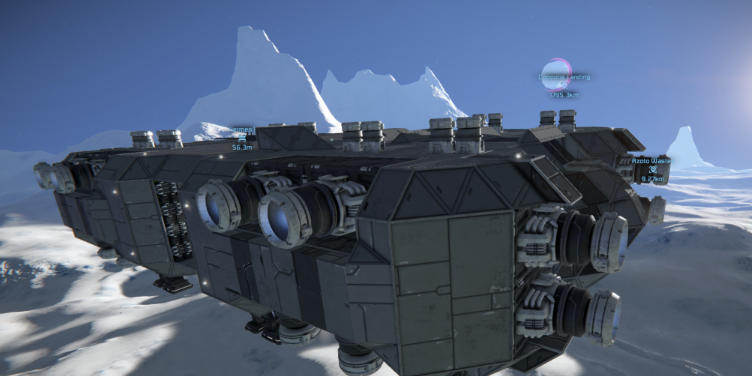
I've been playing Space Engineers for a very long time, and if there's one thing that has always felt frustrating, it's how atmospheric flight works. Every friend I've played with feels the same way: the game is incredible at engineering, but it punishes you for building anything that looks like a real aircraft.
The Problem:
Right now, ships in atmosphere behave identically to ships in a vacuum. If you design a jet with thrusters only in the back, it’s basically useless. The moment you cut the engines, you drop like a stone. There’s no gliding, no lift, and no air resistance. To stay level, you’re forced to point the nose up or cover the hull in thrusters facing all 6 directions. This makes the shape of your ship purely cosmetic. In a game about engineering, a sleek jet and a flying brick should not perform exactly the same.
The Proposal:
I hope the team can consider a simplified aerodynamic model where the atmosphere actually interacts with the grid. We don’t need a complex NASA simulation, just two basic forces:
- Atmospheric Drag: Based on the grid’s cross-section and speed. This would let ships bleed off speed naturally.
- Atmospheric Lift: Based on the angle of attack. If a ship has forward velocity and tilts its nose up, the air should push the grid upward.
Why this makes sense for SE2:
- Completing the Planetary Experience: Some might say "it's a space game," but SE already has wheels, gravity, and now even water. These features show that planetary gameplay is a core part of the experience. Adding basic aerodynamics isn't a distraction from space - it's the missing piece that makes planets feel alive and rewards players for designing specialized atmospheric craft.
- Technical Feasibility: Calculating a single force vector based on a bounding-box approximation is computationally light. Since the engine is already being built to handle wind forces on grids, a drag/lift system feels like a natural extension of that framework.
- Emergent Gameplay: This would create entirely new reasons to build. Runways, hangars, and specialized planetary transporters would finally have a functional purpose. It makes the sandbox deeper without overcomplicating it.
- Optional & Non-Breaking: This could easily be a world setting. It wouldn't break "thruster-heavy" ships, but it would finally make aerodynamic, fuel-efficient planes a viable choice for those who want them.
A note on timing:
I’m not asking for this to be rushed into the next update. I understand there is a roadmap and higher priorities. This is a suggestion for the long-term vision of SE2. Whenever you feel the engine is ready for it, I believe it would be a massive evolution for the game.
I'd love to hear your thoughts - especially if you've tried building atmospheric aircraft and ran into the same wall. I’d appreciate any feedback or alternative ideas on this. If this is something you feel is missing from the planetary experience, I hope we can bring more attention to this topic.
 I like this feedback
The atmospheric drag coefficient Cw could be calculated from the most forward blocks in the cross section, weighted according to shape. In the sense that slopes that are gradually extending outward contribute less resistance. That is how From The Depth does it. I can still see loopholes, but it is a good start. Repeat the calculation for each side of the ship, then you also have resistances for moving sideways, up and down and backwards. When angling the ship upwards, this could also provide lift.
The actual resistance is then calculated from the size of the cross section, the Cw value and the square of the velocity. Cross section and Cw value are constant as long as the ship is not altered, either through a collision or the player making changes. That makes the calculation computationally cheap indeed. Only when the ship changes shape, the Cw value would have to be recalculated.
Edit: For modest pressure differentials, AFAIK air behaves like thinner water. The same system could be used in water and air, with the part of the cross section over water being assigned a much lower Cw
Edit #2: If there are internal thrusters, look for blocks behind the thruster and apply their drag to the exhaust of the thruster. That could seriously deter the habit of using internal thrusters.
The atmospheric drag coefficient Cw could be calculated from the most forward blocks in the cross section, weighted according to shape. In the sense that slopes that are gradually extending outward contribute less resistance. That is how From The Depth does it. I can still see loopholes, but it is a good start. Repeat the calculation for each side of the ship, then you also have resistances for moving sideways, up and down and backwards. When angling the ship upwards, this could also provide lift.
The actual resistance is then calculated from the size of the cross section, the Cw value and the square of the velocity. Cross section and Cw value are constant as long as the ship is not altered, either through a collision or the player making changes. That makes the calculation computationally cheap indeed. Only when the ship changes shape, the Cw value would have to be recalculated.
Edit: For modest pressure differentials, AFAIK air behaves like thinner water. The same system could be used in water and air, with the part of the cross section over water being assigned a much lower Cw
Edit #2: If there are internal thrusters, look for blocks behind the thruster and apply their drag to the exhaust of the thruster. That could seriously deter the habit of using internal thrusters.
disagree, this should be a mod not vanilla , just like it is in SE1
disagree, this should be a mod not vanilla , just like it is in SE1
Hello!
I agree that aerodynamics should be part of the game, however, I must disagree with your proposed solution.
The proposed solution has three major problems:
I therefore propose My Refined Solution: Dedicated Aerodynamic Blocks
Instead of applying a bounding-box or cross section based aerodynamic force to the whole grid, the game should feature a set of dedicated aerodynamic blocks such as 'aerofoils', 'ailerons', and 'wing' blocks.
Why? Because dedicated aerodynamic blocks provide:
Kind Regards,
Kiera Rose
Hello!
I agree that aerodynamics should be part of the game, however, I must disagree with your proposed solution.
The proposed solution has three major problems:
I therefore propose My Refined Solution: Dedicated Aerodynamic Blocks
Instead of applying a bounding-box or cross section based aerodynamic force to the whole grid, the game should feature a set of dedicated aerodynamic blocks such as 'aerofoils', 'ailerons', and 'wing' blocks.
Why? Because dedicated aerodynamic blocks provide:
Kind Regards,
Kiera Rose
If they did a simple width and height calc to get front facing area, they could apply a simple drag assumption to that. Would be annoying for fuel wise, but would help with ships that are designed to survive on that drag. Doing lift calculations is much harder though. I like the idea of making ships that live on drag.
Fair warning... but you will now be subject to cross wind problems too. lol
If they did a simple width and height calc to get front facing area, they could apply a simple drag assumption to that. Would be annoying for fuel wise, but would help with ships that are designed to survive on that drag. Doing lift calculations is much harder though. I like the idea of making ships that live on drag.
Fair warning... but you will now be subject to cross wind problems too. lol
"flying brick" is a design philosophy. and aerodynamics have their own role to play against it.. GENERALLY block ships are going to have a heavyer thrust output regardless, so it OVERCOMPENSATES for any negligable aerodynamic interaction. unless you are flying through a blizzard (which i had done recently in both se2 and se1 with a similar ship design) and yeah.. i got blown around like my ship was a the sail it is.
specifically desinging a ship to interact with the environment is ONE playstyle. if the games physics lets someone play that way, awesome, if not.... its just how the game should play.
you KNOW loads of people are gonna be building submarines when liquid water comes into play and its gonna create a whole different set of challenges to play with.
"flying brick" is a design philosophy. and aerodynamics have their own role to play against it.. GENERALLY block ships are going to have a heavyer thrust output regardless, so it OVERCOMPENSATES for any negligable aerodynamic interaction. unless you are flying through a blizzard (which i had done recently in both se2 and se1 with a similar ship design) and yeah.. i got blown around like my ship was a the sail it is.
specifically desinging a ship to interact with the environment is ONE playstyle. if the games physics lets someone play that way, awesome, if not.... its just how the game should play.
you KNOW loads of people are gonna be building submarines when liquid water comes into play and its gonna create a whole different set of challenges to play with.
Think of the immense effort developers are putting into creating a true volumetric simulation. Ignoring that in ship designs is just an insane waste!
I don't care about the community being divided. Just let server admins toggle it off—and let them be happy with their specific audience.
In time, we'll see which option the majority prefers.
Think of the immense effort developers are putting into creating a true volumetric simulation. Ignoring that in ship designs is just an insane waste!
I don't care about the community being divided. Just let server admins toggle it off—and let them be happy with their specific audience.
In time, we'll see which option the majority prefers.
You are arguing about air drag and whatever seems realistic ...that's fine.
In the meanwhile the SE2 (like SE1) is based on a Tolemaic system 2.0 (the star rotates around every planet) instead of the Heliocentic one (Copernican system for the naives). LOL
You are arguing about air drag and whatever seems realistic ...that's fine.
In the meanwhile the SE2 (like SE1) is based on a Tolemaic system 2.0 (the star rotates around every planet) instead of the Heliocentic one (Copernican system for the naives). LOL
There have been discussions about how rotating (planets!) could be implemented in a greater environment. There seems no easy answer. Possibilities include:
There have been discussions about how rotating (planets!) could be implemented in a greater environment. There seems no easy answer. Possibilities include:
Replies have been locked on this page!