


This object is in archive!

Compact rotors
Under Consideration
It is good to see that motors are coming soon and the models look fine.
I will assume that the smallest rotor will have both torque and endurance limits that will make it unsuitable for heavy loads or have much resistant to damage.
I have been watching videos on advanced motor tech and looked at the Axial Flux Motor that has been developed and now adopted by Mercedes for their electric vehicles.
These motors are flat wide around the axial giving a compact design.
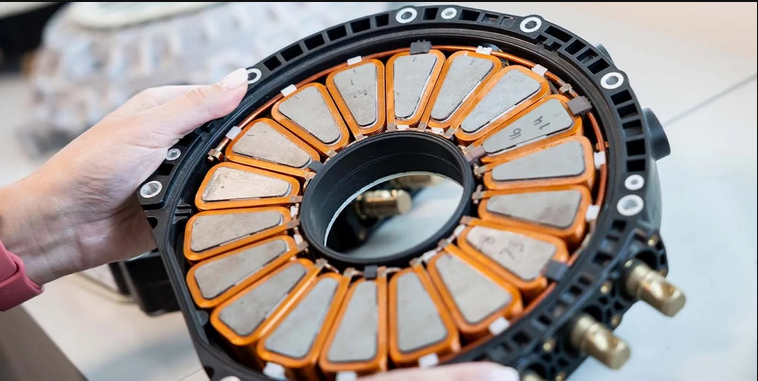
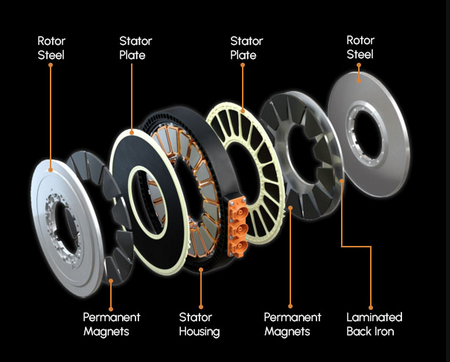
The unified grid system allows for more versatility in block dimensions.
A compact motor rotor will allow greater creativity in over coming design constraints.
 I like this feedback
 You can't vote. Please authorize!
Almost forgot to mention Robert Farrugia's post on Better Rotors and/or Gimbals - who suggested this some time ago - now archived https://support.keenswh.com/spaceengineers2/pc/topic/46630-better-rotors-andor-gimbals
Almost forgot to mention Robert Farrugia's post on Better Rotors and/or Gimbals - who suggested this some time ago - now archived https://support.keenswh.com/spaceengineers2/pc/topic/46630-better-rotors-andor-gimbals
The rotors look... They are clearly designed to be mounted above the surface, not built into the surface/floor. They are unnecessarily tall and quite impractical. In my opinion, rotors designed to be embedded in the surface should look like this:
The rotor can extend by 0.25 m (similar to the rotor in SE1). The smaller rotor has estimated dimensions of 1.5 x 1.5 x 1 meter, the larger one 2.5 x 2.5 x 1 meter. Both have a conveyor running through them. They are intended as a base for a weapon (weapon turret) or work equipment (crane, excavator, etc.).
The turret presented on Steam has a nice design, but the one-sided suspension has a drastic effect on shooting accuracy. The barrel of the weapon should pass through the axis of the suspension, again for the sake of accuracy and stability when firing. A double-sided fork suspension does not look as "dynamic," but it provides a much more stable mount for the weapon.
The mount should/could also be lower – a large negative elevation is quite unnecessary, and a low turret height is more important. In addition, turrets with small-caliber weapons are used more for defending the interior of ships, where it is more appropriate to mount the turret with the weapon on the ceiling of the space in an "upside down" position. The low height above the surface then allows characters to pass "under the turret" without restriction.
By the way, when talking about rotors and weapon mounts, I remembered a half-forgotten weapon with an interesting mounting solution. https://www.valka.cz/CZK-vz-CS-57-mm-PL-kanon-t1110 ; https://www.armedconflicts.com/CZK-vz-CS-57-mm-PL-kanon-t1110
The rotors look... They are clearly designed to be mounted above the surface, not built into the surface/floor. They are unnecessarily tall and quite impractical. In my opinion, rotors designed to be embedded in the surface should look like this:
The rotor can extend by 0.25 m (similar to the rotor in SE1). The smaller rotor has estimated dimensions of 1.5 x 1.5 x 1 meter, the larger one 2.5 x 2.5 x 1 meter. Both have a conveyor running through them. They are intended as a base for a weapon (weapon turret) or work equipment (crane, excavator, etc.).
The turret presented on Steam has a nice design, but the one-sided suspension has a drastic effect on shooting accuracy. The barrel of the weapon should pass through the axis of the suspension, again for the sake of accuracy and stability when firing. A double-sided fork suspension does not look as "dynamic," but it provides a much more stable mount for the weapon.
The mount should/could also be lower – a large negative elevation is quite unnecessary, and a low turret height is more important. In addition, turrets with small-caliber weapons are used more for defending the interior of ships, where it is more appropriate to mount the turret with the weapon on the ceiling of the space in an "upside down" position. The low height above the surface then allows characters to pass "under the turret" without restriction.
By the way, when talking about rotors and weapon mounts, I remembered a half-forgotten weapon with an interesting mounting solution. https://www.valka.cz/CZK-vz-CS-57-mm-PL-kanon-t1110 ; https://www.armedconflicts.com/CZK-vz-CS-57-mm-PL-kanon-t1110
Rotor dimensions are a bit up in the air... SE1's small rotors were quite small and if they get equivalents in SE2 then we'll be fine. As for turret stabilization via fork-mounts... I forget where but I am fairly certain they said they are bringing hinges in to SE2 as well, it should solve the issue unless you're getting really crazy with things (wouldn't be the first tower of death capable of 45 degree depression that I've seen).
Rotor dimensions are a bit up in the air... SE1's small rotors were quite small and if they get equivalents in SE2 then we'll be fine. As for turret stabilization via fork-mounts... I forget where but I am fairly certain they said they are bringing hinges in to SE2 as well, it should solve the issue unless you're getting really crazy with things (wouldn't be the first tower of death capable of 45 degree depression that I've seen).
Replies have been locked on this page!